How to Price Your Smoke Shop Products: A Complete Smoke Shop Pricing Strategy
Pricing decisions happen every day. Most shop owners go with their gut or match whatever the guy down the street charges. That's leaving real money on the table. A solid smoke shop pricing strategy is the single fastest way to increase your bottom line without spending a dime on marketing, new inventory, or extra staff.
Keystone Pricing Explained: The 2x Markup Baseline
Keystone pricing is simple: you double your wholesale cost. Buy a grinder for $6, sell it for $12. Buy a vape pen for $15, sell it for $30. It's been the default in retail for decades, and it's a decent starting point — but it's only a starting point.
The keystone model gives you a 50% gross margin across the board. For a smoke shop, that's roughly in the right neighborhood. Most shops aim for a blended margin of around 45-55%, which we covered in detail in our guide on smoke shop profit margins.
Here's the problem with applying keystone blindly: not all products should carry the same margin. A $4 lighter and a $400 dab rig serve completely different purposes in your store. The lighter needs to move fast at a competitive price. The rig can sit on a shelf for weeks and still make you money with a higher markup. Treating them the same is a mistake.
Takeaway: Use keystone as your default, then adjust up or down by category based on competition, velocity, and perceived value.
Pricing by Product Category
Every product category in your shop has its own pricing dynamics. Here's how to think about each one.
Disposable Vapes: 30-45% Margin
Disposables are your volume play. You're typically buying them from disposable vape wholesalers for around $5-8 per unit and selling for $10-15. The margins are thinner than other categories, but the velocity makes up for it.
Don't try to squeeze extra margin here. Your customers know what these cost. They've checked the price at three other shops and probably two gas stations. Price your top-selling disposable brands within $1 of the local average. Where you can push margins is on newer brands your customers haven't price-anchored yet.
Glass Pipes, Bongs, and Rigs: 50-70% Margin
Glass is where your pricing flexibility really opens up. A basic spoon pipe you bought for $5 can sell for $15-20 without anyone questioning it. A unique heady piece with no direct comparison? You can mark that up 3x or even 4x.
The key is uniqueness. Mass-produced pieces from the same supplier everyone carries — customers will compare. One-of-a-kind or limited pieces from local artists — customers pay what the piece feels worth. Stock both. Use the commodity glass for volume, the artisan pieces for margin.
CBD and Hemp Products: 45-60% Margin
CBD margins have compressed over the past few years, but they're still strong compared to tobacco and vapes. Tinctures and edibles typically carry the best margins at around 55-60%. Flower and pre-rolls are more competitive at roughly 40-50%.
One tip: if you carry a CBD brand nobody else in your area stocks, you can price it however you want. Customers can't comparison shop what they can't find elsewhere. This is a good reason to build relationships with smaller brands through a wholesale supplier directory.
Accessories: 55-75% Margin
Rolling papers, lighters, trays, screens, torches, cleaning supplies, stash jars — accessories are your quiet profit center. They're low-cost impulse buys, and customers rarely comparison shop a $4 pack of papers or a $12 rolling tray.
Don't be afraid to mark accessories up aggressively. A $2 wholesale lighter sold for $4.99 won't raise any eyebrows. A $6 grinder sold for $16.99 is perfectly standard. These small items add up fast when you're moving dozens per day.
Tobacco and Cigars: 25-40% Margin
Traditional tobacco products carry the tightest margins in your shop. Between state excise taxes, minimum pricing laws, and heavy brand competition, there's less room to maneuver. Many states set minimum prices on cigarettes, which means your margin is essentially fixed by law.
Premium cigars are the exception. A $3 wholesale cigar sold for $8-12 is completely normal. Single-stick premium cigar margins can easily hit 60%.
Takeaway: Treat disposables and tobacco as traffic drivers. Make your real money on glass, accessories, and unique CBD products.
Competitor Pricing: How to Research Without a Race to the Bottom
You need to know what competitors charge. You don't need to match them.
Start by picking your 3-5 closest competitors. Visit them once a month. Check prices on 10-15 key products — your top-selling disposable, your most popular glass piece, a few accessories. Write them down. That's your local pricing map.
Here's the counterintuitive part: being the cheapest shop in town is usually a bad strategy. You attract bargain hunters who have zero loyalty. The moment someone undercuts you by fifty cents, they're gone. And you've trained your good customers to expect low prices, which is a hole that's very hard to climb out of.
Instead, aim to be competitive on the 5-10 products customers actually price-check (typically the most popular disposable brands and basic accessories) and price for margin on everything else. Most customers don't walk in with a price list. They check one or two items they buy regularly. If those feel fair, they assume the rest is fair too.
Takeaway: Match the market on your highest-visibility SKUs. Price for profit on everything else.
Psychological Pricing Tricks That Actually Work
These aren't gimmicks. They're backed by decades of retail research and they work in smoke shops just like anywhere else.
Charm Pricing ($X.99)
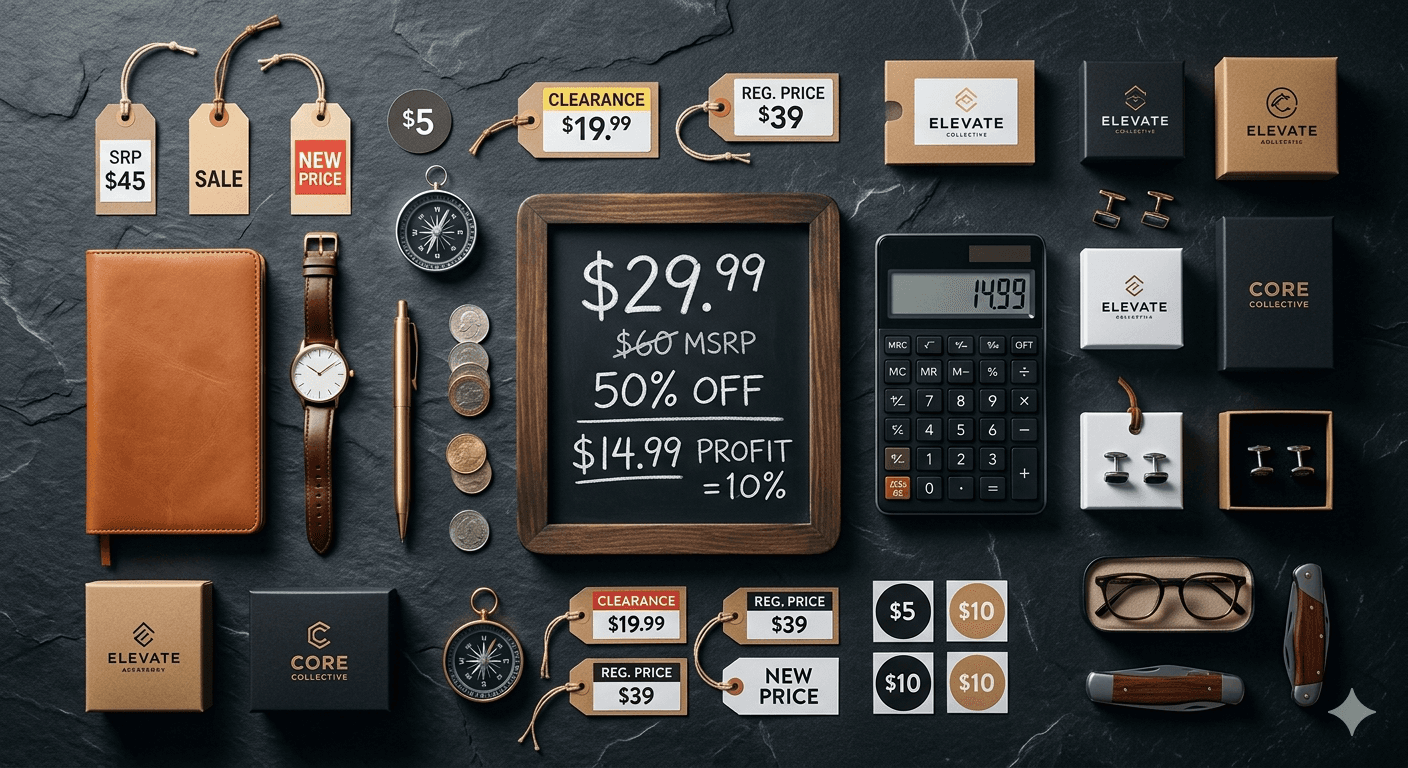
There's a reason nearly every retailer on the planet ends prices in .99. A product at $9.99 genuinely feels cheaper than one at $10.00, even though the difference is a penny. Use .99 endings on anything under $50. For premium items over $50, round numbers ($75, $120) can actually signal higher quality.
Price Anchoring
Put a $350 rig next to a $120 rig and the $120 suddenly feels like a deal. This works with display placement too. Arrange your glass case so the most expensive piece is the first thing customers see. Everything after it feels more affordable by comparison.
Bundle Pricing
A pipe plus a grinder plus papers for $24.99 — when the items separately total $31. You move more product, the customer feels like they got a deal, and your actual margin on the bundle can still hit 55-60% because you're bundling high-margin accessories with a mid-margin piece.
Tiered "Good-Better-Best"
For any product category, stock three tiers. The budget option makes the mid-tier look reasonable. The premium option makes the mid-tier look smart. Most customers pick the middle. Price your mid-tier where you want your margin to land.
Takeaway: You don't need to lower prices to sell more. You need to frame prices so they feel right.
Common Pricing Mistakes Smoke Shop Owners Make
Pricing Everything at Keystone
We covered this, but it's worth repeating. A flat 2x markup across every product means you're undercharging on accessories and overcharging on high-velocity vapes. Differentiate by category.
Ignoring Carrying Costs
That $200 glass piece sitting on your shelf for four months has a real cost — the capital tied up in it could've been spent on disposables that turn over weekly. If something sits for 60+ days, discount it and redeploy that cash into faster-moving inventory.
Raising Prices Too Slowly
Costs go up constantly — wholesale prices, rent, insurance, labor. If you haven't raised prices in over a year, you've effectively given yourself a pay cut. Bump prices by 3-5% annually on your full catalog. Most customers won't notice incremental increases. They absolutely notice a sudden $3 jump.
Forgetting About Perceived Value
A clean, well-lit display case with organized shelving and printed price cards makes the same products feel more premium than a cluttered counter with handwritten stickers. You can charge more in a shop that looks like it's worth more.
Not Tracking Margins by Category
If you don't know your actual margin on disposable vapes versus glass versus accessories, you're flying blind. Spend an hour with your POS data once a month. Sort by category, check your actual versus target margins, and adjust. That one hour can be worth hundreds in recovered margin.
Takeaway: Most pricing mistakes aren't about the number on the sticker. They're about not paying attention.
When to Discount (and When Not To)
Discounting should be a scalpel, not a sledgehammer.
Good Reasons to Discount
- Slow-moving inventory: If it's been on the shelf 60+ days, mark it down 15-25% and move on. Dead stock costs you money every day it sits there.
- Bundle deals: Bundling lets you give a perceived discount while maintaining margin on the total transaction.
- Loyalty rewards: Give your regulars 10% off once a month, or a free accessory after a certain spend threshold. This rewards loyalty without training everyone to expect lower prices.
- New product introductions: A temporary "try it" price on a new brand can build repeat customers. Just set a clear end date.
Bad Reasons to Discount
- Matching a competitor's fire sale. Let them lose money. You don't have to.
- Slow Tuesday. Discounting because foot traffic is low doesn't fix the traffic problem and erodes your margin.
- "Getting people in the door." Steep discounts attract deal-seekers, not loyal customers. They won't come back at full price.
- Holidays, just because. Everyone discounts on 4/20. If you're going to discount, make it strategic — bundle deals or threshold offers ($50+ gets a free lighter) instead of blanket percentage-off sales.
Takeaway: Every discount should have a clear business reason and an end date. If you can't articulate why you're discounting, don't.
FAQ
What's a good overall profit margin for a smoke shop?
Most smoke shops aim for a blended gross margin of around 45-55% across all product categories. After overhead, a healthy net margin is typically 15-25%. Your exact numbers depend heavily on your product mix, location, and rent costs. Check our detailed breakdown in the smoke shop profit margins guide.
How often should I review and adjust my prices?
At minimum, do a full pricing review every quarter. Check your POS reports monthly to spot categories where margins are slipping. And any time your wholesale costs change — which is happening more frequently — adjust your retail prices within a week. Don't absorb cost increases.
Should I price match competitors?
Only on your highest-visibility products — typically 5-10 SKUs that customers actively price-compare. For everything else, price based on your target margin. Most customers don't comparison shop your entire inventory. They just need to feel your prices are in the right ballpark.
How do I handle pricing on products with minimum advertised price (MAP) policies?
MAP policies actually help you. They prevent online sellers and big chains from undercutting your price. Stick to the MAP price — don't go below it (you'll risk losing the brand relationship) and don't feel like you need to go above it unless your market supports it.
What's the best POS system for tracking smoke shop margins?
Several POS systems work well for smoke shops, including Dutchie, KORONA, and Lightspeed. The most important features are category-level margin reporting, inventory aging reports, and easy price adjustment tools. Whatever system you choose, the key is actually using the data — pull a margin report at least once a month.
Build Your Pricing Strategy on Better Wholesale Costs
The best pricing strategy in the world can't fix bad wholesale costs. If you're paying too much for inventory, your margins will always be tight no matter how clever your pricing.
That's where sourcing matters. Browse verified wholesale suppliers on SmokeAxis to compare distributors, request quotes, and find better pricing on the products your shop needs. Better wholesale costs give you the room to price competitively and still protect your margins.