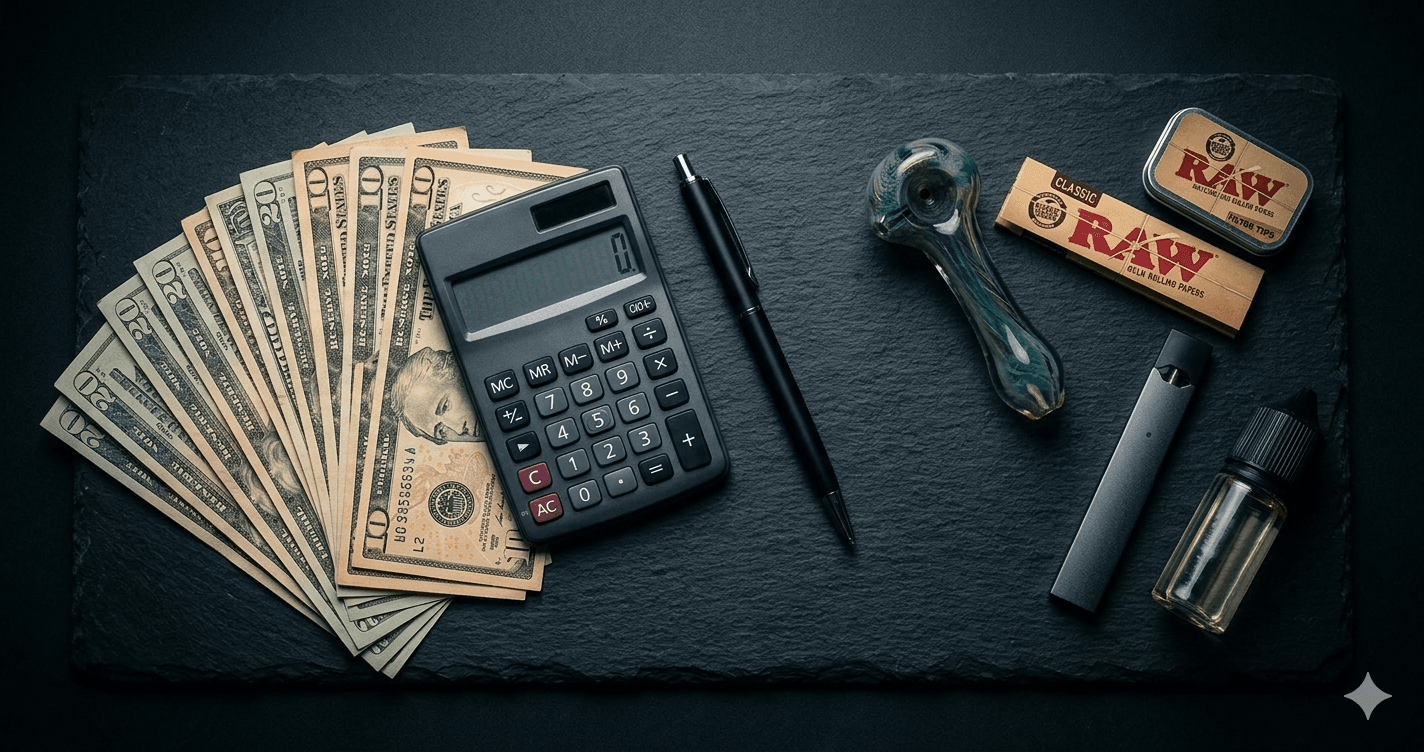
Smoke Shop Profit Margins: What You Can Actually Expect
Understanding smoke shop profit margins isn't just about knowing which products have the highest markup. It's about knowing which products actually put the most money in your register at the end of the month. Those are two very different things.
The Big Picture: What Does an Average Smoke Shop Make?
Here's the hardest data available on what independent shops actually take home: smoke shops sold on BizBuySell between 2021 and 2025 reported a median of $420,000 in annual revenue and $100,000 in owner earnings — just under a quarter of revenue ending up in the owner's pocket before debt service and taxes.
Medians hide a wide spread, though. A shop in a low-rent strip mall outside Tulsa has a completely different cost structure than a shop on a busy street in Brooklyn. Your lease alone can swing your net margin by 10 points.
But gross margin is where you have the most control. And it varies dramatically depending on what you stock.
Profit Margins by Product Category
Disposable Vapes: 30-45% Gross Margin
Disposable vapes are typically the volume leader in most smoke shops today. You're buying them wholesale for around $5-8 per unit and selling for $10-15, depending on your market and the brand.
The margins aren't spectacular. But the velocity is. A busy shop might move 300-600 disposable units per month. At an average profit of roughly $4 per unit, that's $1,200-$2,400 in gross profit from a single product category. That's rent money.
The catch? Disposables are price-sensitive. Your customer knows what they cost at the shop two blocks over. Pricing yourself even $1 too high on a popular SKU can send them walking. If you're sourcing from solid disposable vape wholesalers, you can usually get volume pricing that keeps your margins healthy without scaring off customers.
Refillable systems and e-liquids carry slightly better margins — typically around 40-50% — but move slower.
Glass Pipes and Accessories: 50-70% Gross Margin
Glass is where things get interesting. Basic spoon pipes and chillums you buy for $3-8 wholesale and sell for $10-25. That's a solid 60-70% margin on the low end of the price range.
Mid-range glass — bubblers, small bongs, themed pieces — typically runs a 50-60% margin. You're buying for $15-40 and selling for $35-90.
High-end heady glass and artist pieces operate on a different model entirely. Margins can hit 100%+ on pieces from known artists, but they sit on your shelf longer and tie up capital. A $200 piece that takes three months to sell earned you less per month than a $15 pipe you replace every week.
Here's the counterintuitive part: your overall glass profit usually comes from the cheap stuff. A steady stream of $12-20 glass sales at 65% margin almost always outperforms a handful of premium sales at higher margins. The exception is if you've built a reputation as a glass destination — then the high-end stuff moves faster and the math changes. Finding reliable glass pipe distributors who can keep you stocked on both ends of the price range matters more than most shop owners realize.
CBD and Hemp Products: 50-65% Gross Margin
CBD has settled into a mature market, which is actually good news for margins. The brands that survived the shakeout are the ones with stable wholesale pricing and real customer demand.
CBD tinctures typically carry around 55-65% gross margin. Gummies and edibles sit around 50-60%. Topicals and creams tend toward the lower end at 45-55%, partly because they take up more shelf space per dollar of profit.
Pre-rolls and hemp flower are a different story. If you can source quality flower at $30-60 per ounce wholesale and sell pre-rolls at $8-12 each, you're looking at margins that can push past 70%. The key word is quality — customers can tell the difference between properly cured hemp and the dry stuff that's been sitting in a warehouse.
Connecting with the right wholesale suppliers lets you test smaller quantities before committing to deep inventory on any single brand. That matters because CBD brands rise and fall faster than most other product categories.
Kratom and Botanicals: 55-70% Gross Margin
Kratom has quietly become one of the highest-margin categories in the smoke shop world. Wholesale costs for quality kratom powder typically run around $25-50 per kilo, and retail pricing lands at roughly $12-20 per ounce in most markets.
Run the numbers. A kilo has about 35 ounces. Buy a kilo for $40, sell 35 ounces at $15 each, that's $525 in revenue on a $40 investment. Even accounting for bags, labels, and the ounces you lose to weighing, you're looking at margins north of 60%.
Capsules and extracts carry lower margins — typically around 45-55% — because the processing costs are baked into the wholesale price. But they're easier to sell and require less of your staff's time per transaction.
The risk with kratom is regulatory. Several states and cities have banned or restricted it, and the FDA continues to scrutinize the category. Stock it where it's legal, but don't build your entire business model on it. Establishing relationships with reputable kratom and botanical suppliers protects you — they'll keep you informed about regulatory shifts and won't sell you adulterated product that creates liability.
Traditional Tobacco and Cigars: 20-35% Gross Margin
Cigarettes are the lowest-margin product in your shop. Period. In most states, you're looking at 10-15% gross margin on cigarettes, and after the cost of your tobacco license and compliance, the effective margin is even thinner.
Premium cigars are better, typically running 35-50% gross margin. A $4 wholesale cigar selling for $7-9 is respectable. Cigar accessories — cutters, humidors, lighters — can push 50-60%.
Cigarette papers, rolling tobacco, and pipe tobacco generally fall in the 30-40% range. Not exciting, but they're consistent sellers with loyal repeat customers.
Here's why you still stock the low-margin tobacco: it drives foot traffic. A customer who comes in for a pack of cigarettes and walks out with a disposable vape and a lighter just turned a 12% margin trip into a blended 35%+ margin trip. Tobacco is your traffic driver, not your profit center.
What Actually Kills Your Margins
Product cost is only half the equation. Most shop owners who struggle with smoke shop profit margins aren't getting crushed on wholesale prices — they're bleeding out from operational leaks.
Shrinkage eats more than you think. Retail shrink — theft, damage, and miscounted inventory — averaged 1.6% of sales industry-wide in 2022, according to the National Retail Federation's National Retail Security Survey (2023). That might sound small until you realize it comes straight out of your profit margin. At the NRF average, a shop doing $30,000 a month in revenue loses about $480 a month to shrinkage. Glass products are especially vulnerable — one dropped bong erases the profit from 10 sales of the same piece.
Dead inventory is a silent killer. That shelf of CBD tinctures from a brand nobody asks about anymore? Those novelty pipes you overbought for 4/20? Every product sitting on your shelf is money that's not working for you. The rule of thumb: if something hasn't sold in 90 days, discount it and move on. The cash you free up earns more as new, faster-moving inventory.
Overstaff and you're writing checks to empty aisles. Labor is one of the biggest controllable expenses in retail. A busy Saturday afternoon needs three people behind the counter. A Tuesday morning needs one. If you're scheduling the same coverage every day, you're destroying margin on slow days.
Rent above 10-12% of revenue is a red flag. That prime downtown location with $6,000/month rent needs to generate at least $50,000/month in revenue to make sense. Plenty of successful smoke shops operate from second-tier locations at half the rent and make significantly more per dollar of revenue.
How to Improve Your Margins Starting This Week
Rethink Your Product Mix
Look at your last 90 days of sales. Sort every product by gross profit dollars — not margin percentage. You'll almost certainly find that 20-30% of your SKUs generate 70%+ of your actual profit.
The products at the bottom of that list? Reduce your reorder quantities or drop them entirely. Replace that shelf space with more of what's actually selling. This sounds obvious, but most shop owners reorder out of habit rather than data.
Negotiate Like You Mean It
Most wholesale distributors have room to move on pricing, especially on volume orders. But you have to ask. A 5% reduction in cost of goods on your top 10 products could add a full point to your net margin.
Don't just negotiate on price. Negotiate on terms. Net-30 payment terms instead of COD mean you've sold the product before you've paid for it. That's free cash flow, and it lets you stock deeper without tying up capital.
If you haven't recently explored your sourcing options, take time to browse verified wholesale distributors across every wholesale product category you stock. Comparing three or four suppliers on your highest-volume items almost always reveals savings you didn't know were available.
Bundle and Upsell Strategically
A customer buying a bong should leave with a bowl, screens, and a cleaner. That $45 glass sale becomes a $65 sale at a blended margin of around 60%. Train your staff to make these connections naturally — not as a hard sell, but as genuinely helpful suggestions.
Pre-built bundles work even better. A "starter kit" with a mid-range piece, a grinder, papers, and a lighter at a slight discount off individual pricing feels like a deal to the customer while actually improving your margin versus selling the anchor product alone.
Control Your Discounting
Across-the-board percentage-off sales are margin destroyers. If you run a 20% off everything sale, you need to increase unit sales by roughly 60% just to break even on gross profit. That almost never happens.
Instead, discount strategically. Mark down slow movers to clear dead inventory. Run promotions on high-margin accessories that pair with full-price anchor products. Use loyalty programs that reward repeat visits rather than slashing prices.
Track Margins Weekly, Not Monthly
A monthly P&L tells you what happened after you can't fix it. Tracking your category-level margins weekly lets you catch problems while they're small. If your vape margins dropped 3 points this week, you can figure out why — a pricing error, a supplier price increase you didn't pass through, a new competitor running a promotion — before it costs you a full month of profit.
Even a simple spreadsheet that tracks weekly revenue and cost by category is enough. You don't need fancy software. You need the discipline to look at the numbers every seven days.
The Margin Mix That Works
The most profitable smoke shops aren't the ones with the highest margins on any single product. They're the ones with the right blend of traffic drivers, profit centers, and impulse buys.
A healthy product mix typically looks something like this: tobacco and cigarettes drive people through the door, vapes and glass generate the bulk of your gross profit, and accessories, lighters, and impulse items pad the margin on every transaction. Kratom, CBD, and botanicals serve as high-margin specialty categories that differentiate you from the gas station down the street.
Don't try to be everything to everyone. A shop that stocks 50 SKUs well — with good depth and consistent availability — will outperform a shop that stocks 200 SKUs with constant out-of-stocks. Your customer would rather know you always have their product than be impressed by a selection they can't rely on.
Frequently Asked Questions
What is the average profit margin for a smoke shop?
The hardest available benchmark: smoke shops sold on BizBuySell from 2021 to 2025 reported median owner earnings of $100,000 on median revenue of $420,000 — about 24% of revenue. Your actual numbers depend heavily on your product mix, location, and how well you manage operating costs. Shops that lean into high-margin categories like glass and kratom while keeping overhead tight tend to land on the higher end.
Which smoke shop products have the highest profit margins?
Glass pipes and accessories generally carry the highest margins at around 50-70%, followed by kratom and botanicals at 55-70%, and CBD products at 50-65%. However, the highest-margin products aren't always the biggest profit contributors in absolute dollars — high-velocity products like disposable vapes often generate more total gross profit despite lower per-unit margins.
How much does a smoke shop owner make per year?
Owner compensation varies widely. The median smoke shop sold on BizBuySell between 2021 and 2025 reported $100,000 in annual owner earnings on $420,000 in revenue. Shops in high-traffic areas with optimized product mixes can exceed that. Multi-location operators obviously scale higher, but so do their headaches.
How can I increase my smoke shop profit margins?
Focus on three areas: sourcing (negotiate better wholesale prices and compare multiple suppliers), product mix (allocate more shelf space to higher-margin categories and cut dead inventory), and operations (control labor costs, reduce shrinkage, and avoid unnecessary discounting). Even small improvements across all three areas compound into meaningful margin gains.
Is owning a smoke shop profitable in 2026?
Yes, but profitability isn't automatic. The smoke shop industry remains strong, with consumer demand for vape products, glass, and botanical products continuing to grow. The shops that struggle are typically the ones with poor inventory management, bad locations, or an unwillingness to adapt their product mix as the market shifts. If you manage your costs and stock what your customers actually want, a smoke shop remains a solid retail business.
Ready to improve your margins with better wholesale pricing? Browse verified wholesale distributors on SmokeAxis and connect directly with suppliers across every product category. Better sourcing is the fastest path to better profits.