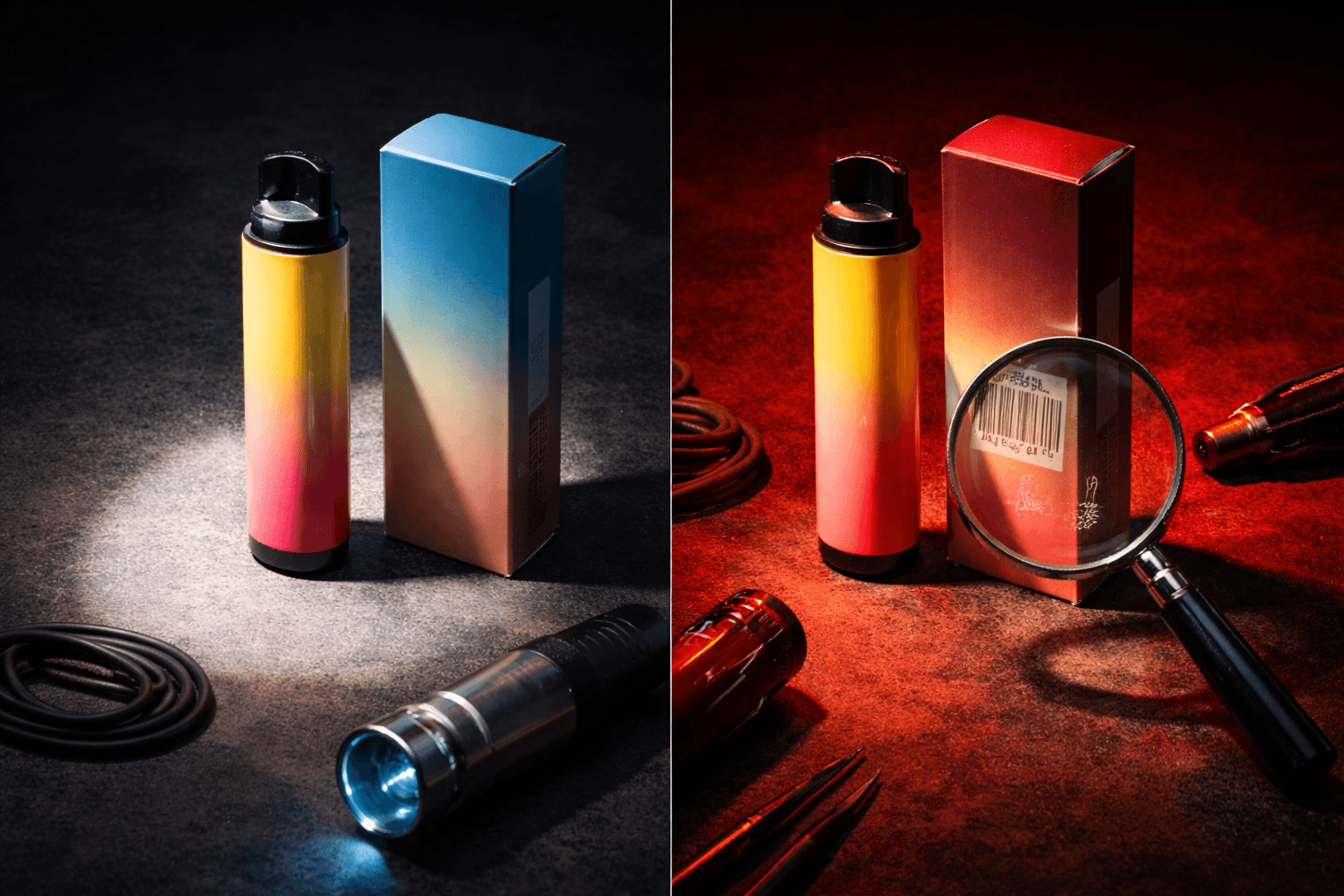
Counterfeit Vapes: How to Spot Fakes in Your Wholesale Orders
Counterfeit vapes wholesale is one of the biggest and most underreported problems in the smoke shop industry. It's not a fringe issue — unauthorized flavored disposables alone accounted for $2.4 billion in 2024 sales, about 35% of tracked US e-cigarette sales, according to Circana retail data reported by Reuters (2025) — and counting every product sold without FDA marketing authorization, Truth Initiative's 2024 analysis of NielsenIQ data puts the unauthorized share at 86%. The fakes are getting better, the supply chains that move them are getting more sophisticated, and the financial and legal consequences for shop owners who sell them are getting worse.
This guide shows you exactly how to protect your shop.
The Counterfeit Vape Problem
Here's what makes counterfeit vapes different from most counterfeit products: they go in someone's lungs. A fake handbag is embarrassing. A fake vape containing unknown chemicals is a health hazard and a liability lawsuit waiting to happen.
Why Counterfeits Are Everywhere
- Massive demand: Disposable vapes like Elf Bar, Lost Mary, Geek Bar, and Flum are the highest-volume products in most smoke shops. Where there's volume, there's incentive to counterfeit
- Easy to copy: Packaging and device housings can be replicated cheaply. A counterfeit factory can produce convincing copies for $1-$2 per unit
- Complex supply chains: Legitimate vape brands manufacture in Shenzhen, China. So do counterfeiters — sometimes in the same industrial parks. Product can change hands 3-4 times between the factory and your shelf
- Price pressure: Shop owners looking for the best wholesale price are the perfect targets. Counterfeiters price just below legitimate wholesale — enough to be attractive without being obviously suspicious
The Risks to Your Business
- Health liability: If a customer has an adverse reaction to a counterfeit vape containing unknown chemicals, you're exposed. Product liability claims can be catastrophic for a small business
- Criminal charges: Selling counterfeit products is a federal trademark violation. Some states have specific statutes that can escalate this to criminal charges, especially for repeat offenders
- FDA enforcement: The FDA has been increasingly active in targeting retail outlets that sell unapproved or counterfeit ENDS products. Seizure of inventory and fines are on the table
- Loss of customer trust: Once customers realize you're selling fakes — and they will — they won't come back. Word spreads fast, especially in tight-knit local smoke shop communities
- Loss of license: State tobacco licensing authorities can revoke your license for selling counterfeit products. Some states like Illinois and Pennsylvania have escalating enforcement provisions
Practical takeaway: Selling counterfeit vapes isn't just bad business — it's a legal, financial, and reputational risk that can end your business. The $1-$2 per unit you "save" is not worth the exposure.
How Fakes Enter the Supply Chain
Here's the counterintuitive part: most counterfeit vapes don't come from obviously shady dealers working out of a van. They come from otherwise legitimate-looking wholesale websites with professional storefronts, responsive customer service, and what appears to be a normal business operation.
Common Entry Points
- Gray market distributors: These are companies that buy excess inventory, returned products, or liquidated stock from various sources. Some of that stock is authentic; some is mixed with counterfeits. The distributor may or may not know
- Third-party marketplaces: Wholesale platforms where multiple sellers list products. Quality control varies wildly. Some sellers are authorized distributors; others are resellers who've sourced from unknown origins
- Overseas direct sourcing: Shop owners who try to buy directly from Chinese manufacturers to cut costs. Unless you have an established relationship with a verified factory, you're rolling the dice on authenticity
- Distributor substitution: A distributor who normally sells authentic product runs out of stock and fills your order with product from an unauthorized source. This happens more often than the industry admits
- Secondary market resellers: Suppliers who buy product from other suppliers (instead of directly from the brand) and resell at a markup. Each link in the chain increases the risk that counterfeit product has been mixed in
Why It's Hard to Catch
- Packaging quality on counterfeits has improved dramatically. Side-by-side comparisons are often nearly identical
- Counterfeits are frequently mixed in with authentic product — a case of 100 units might contain 80 real and 20 fake
- New counterfeit versions appear within weeks of any brand updating their packaging or authentication features
- Many shop owners don't check because they trust their supplier — until they get burned
Practical takeaway: Your supplier relationship is your first line of defense. But trust-based relationships without verification create blind spots. Always verify, even with suppliers you've used for years.
Visual Authentication Checks
These are the physical indicators you can check on every shipment without any special tools:
Packaging
- Print quality: Authentic products have crisp, consistent printing with accurate color matching. Counterfeits often have slightly blurry text, off-color logos, or minor spacing inconsistencies
- Holographic seals: Many brands (Elf Bar, Geek Bar, Lost Mary) use holographic stickers or tape. Check that the hologram has depth and shifts color when tilted. Flat, non-shifting "holograms" are fake
- Batch codes and lot numbers: Authentic products have unique batch codes. If every device in a case has the identical code, that's a red flag
- Weight: Compare the sealed package weight to a known authentic unit. Counterfeits often use cheaper components that change the overall weight slightly
- Spelling and grammar: Check all text on the packaging — instructions, warnings, ingredient lists. Counterfeits frequently have subtle misspellings or awkward phrasing
The Device
- Mouthpiece quality: Authentic devices have smooth, well-finished mouthpieces. Counterfeits often have rough edges, uneven color, or a slightly different shape
- LED indicator: Genuine devices have consistent LED color and placement. Counterfeits may have a different LED color or brightness
- Puff count: If a device advertised as 5,000 puffs dies at 2,000, it's likely counterfeit
- E-liquid quality: Authentic devices have consistent flavor from the first puff to the last. Counterfeits often have a chemical or burnt taste, uneven flavor delivery, or a noticeably different flavor profile from the authentic version
Comparative Checking
Keep one confirmed-authentic unit of your highest-volume products on hand as a reference. When a new shipment arrives, compare:
- Packaging dimensions and color accuracy
- Device weight and finish quality
- QR code placement and print quality
- Holographic seal appearance
Practical takeaway: Train your receiving staff to check at least 3-5 random units per case on every shipment. A 60-second visual check can catch most counterfeits before they hit your shelf.
QR Code and Digital Verification
Most major vape brands now include QR codes or scratch-off authentication codes. These are your strongest tool.
How to Use Them
- Scan the QR code with your phone camera — it should direct you to the brand's official verification website
- Enter the authentication code if there's a scratch-off panel
- Check the result: Authentic products will show a verification confirmation, often with batch details. Fake products will either fail verification, show "already verified" (meaning the code was copied from a real product), or redirect to a suspicious website
What Each Result Means
- "Authentic product verified" — you're good. This code matches the brand's database
- "Code not found" — likely counterfeit. The code doesn't exist in the brand's system
- "Code already verified" — the code was copied from a real product. The first person to scan it got the real one; you got the fake
- "Verification limit reached" — similar to above. The code was scanned too many times, suggesting it's been duplicated across multiple counterfeit units
Brand-Specific Verification
- Elf Bar: Uses QR codes on packaging that link to elfbar.com verification
- Geek Bar: QR code verification through their official website
- Lost Mary: Scratch-off code verification
- Flum: QR code authentication
Practical takeaway: Scan 3-5 units per case before accepting a shipment. If even one comes back as fake or already verified, reject the entire case and escalate with your supplier immediately.
What to Do If You Receive Fakes
If you discover counterfeit product in a shipment:
- Stop selling immediately — pull any suspect product from your shelves
- Document everything — photograph the packaging, devices, QR scan results, invoices, and shipping labels
- Contact your supplier — demand a full refund or replacement. Their response tells you a lot: a legitimate distributor will act immediately; a bad one will stall or blame you
- File a chargeback if you paid by credit card and the supplier won't cooperate
- Report to the brand — major vape brands have anti-counterfeit teams and want to know about distribution channels selling fakes
- Consider reporting to authorities — the FDA, your state attorney general's office, and US Customs and Border Protection all handle counterfeit product enforcement
- Review your supplier relationship — one incident might be an honest mistake. Two means it's time to find a new supplier
How to Vet Suppliers to Avoid Counterfeits
The best defense is choosing the right supplier in the first place:
Verify Brand Authorization
- Ask the supplier: "Are you an authorized distributor for [brand]?"
- Verify independently by contacting the brand. Most major vape brands list their authorized US distributors on their website
- If the supplier claims authorization but the brand doesn't confirm it, that's your answer
Check Business Credentials
- Physical warehouse address (not just a PO Box or virtual office)
- State business registration
- Years in operation (check state corporation records)
- Industry association memberships (not required, but a signal of legitimacy)
Evaluate Pricing
- If their pricing on popular brands is more than 10-15% below what other distributors charge, ask why. Legitimate explanations exist (bulk purchasing, promotional pricing), but significant underpricing is the #1 indicator of counterfeit product
- Request a price list and compare across 3-4 distributors. The market has relatively consistent pricing — extreme outliers are red flags
Start Small
- Place a small initial order (1-2 cases) and authenticate every unit before committing to larger volumes
- Test the product yourself — taste, build quality, puff count, QR verification
- If the first order checks out, gradually increase volume
For comprehensive supplier vetting guidance, read our guide to finding wholesale suppliers for your smoke shop. You can also browse verified vape distributors on SmokeAxis to find authenticated suppliers.
Frequently Asked Questions
How common are counterfeit vapes?
Unauthorized flavored disposables made up about 35% of tracked US e-cigarette sales in 2024 — $2.4 billion — according to Circana data reported by Reuters (2025). The problem is most severe with high-volume brands like Elf Bar, Geek Bar, and Lost Mary. Even experienced shop owners get caught occasionally — the counterfeits are that good.
Can I get in legal trouble for selling counterfeit vapes?
Yes. Selling counterfeit products is a federal trademark violation that can result in civil penalties, criminal charges for repeat or knowing violations, inventory seizure by federal authorities, and loss of your tobacco retail license at the state level. The fact that you didn't know they were fake isn't always a defense — courts may consider whether you took reasonable steps to verify authenticity.
What brands are most commonly counterfeited?
The highest-volume disposable vape brands are the most frequently counterfeited: Elf Bar, Geek Bar, Lost Mary, Flum, and HQD. Essentially, if it's a best-seller, someone's making a fake version. Less popular brands are counterfeited less often because the market incentive is smaller.
Should I buy directly from China to get better prices?
This is extremely risky for counterfeit exposure. Unless you have a direct, verified relationship with the brand's official manufacturing facility, buying from Chinese suppliers increases your chances of receiving counterfeit product. Even factories in the same industrial park as legitimate manufacturers may produce counterfeits. Use authorized US-based distributors.
How do I train my staff to spot fakes?
Create a simple checklist: packaging quality, holographic seal check, QR code scan, and weight comparison against a known-authentic reference unit. Train new employees on receiving day — show them a real unit and point out the authentication features. Make spot-checking 3-5 units per case a mandatory part of your receiving process.
Find verified vape distributors on SmokeAxis. Browse the disposable vape supplier directory to compare authorized wholesale distributors.