Smoke Shop E-Commerce: Should You Sell Online?
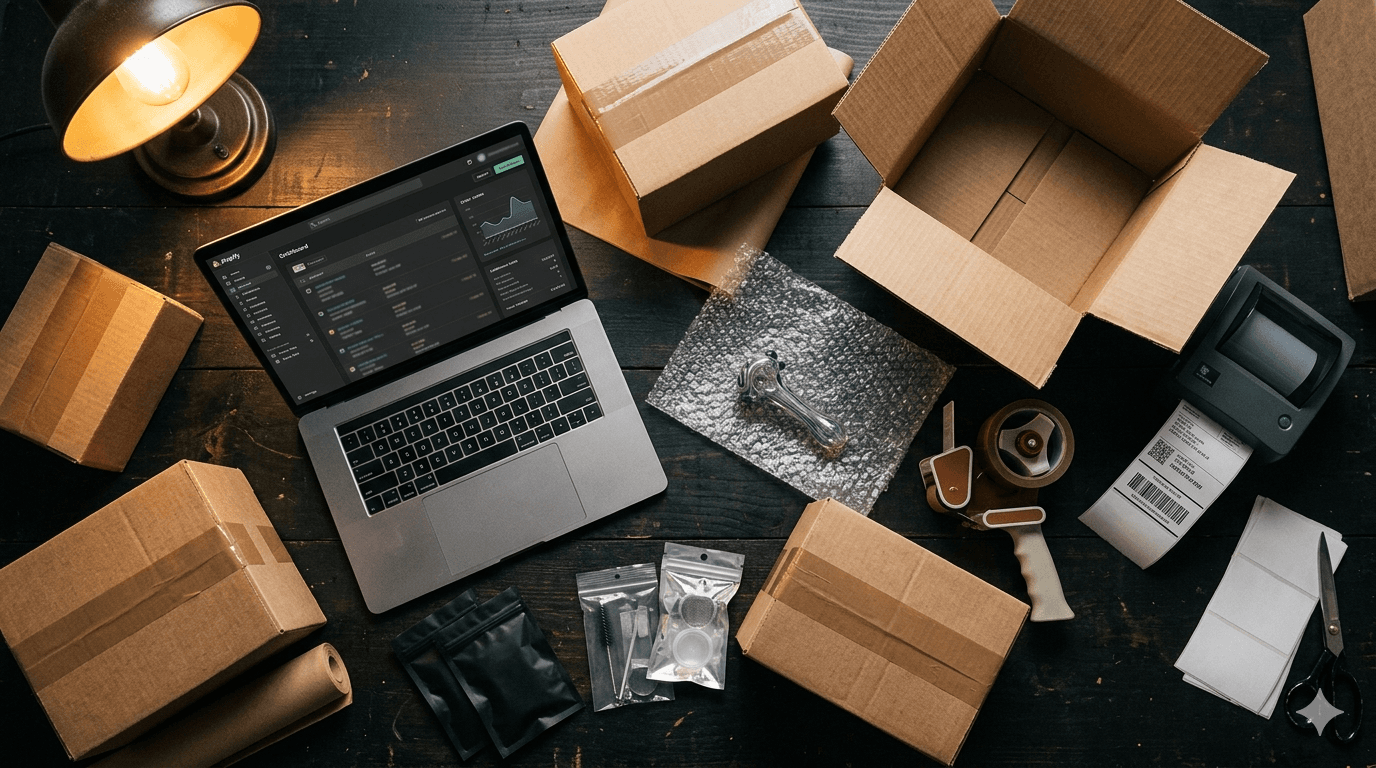
Plenty of smoke shop owners launch an online store expecting a second revenue stream that runs around the clock — and quietly shut it down a few months later. Once the platform subscription, payment processing, and shipping supplies are paid for, and once you count the hours that fulfillment, customer service, and inventory management actually eat, the net can be a fraction of what they pictured. More than a few end up closing the store and refocusing on the physical shop they already had.
The idea of a smoke shop online store is appealing — who wouldn't want revenue coming in 24/7 from customers nationwide? But the reality is more complicated than most smoke shop owners expect. The PACT Act severely restricts what you can ship. Payment processors flag tobacco-adjacent businesses. Advertising platforms won't promote your store. And the products you CAN legally sell online face stiff competition from established e-commerce players.
That doesn't mean e-commerce is always wrong for smoke shops. It means you need to go in with eyes open about what works, what doesn't, and what could get you in serious legal trouble.
The PACT Act: The Wall You Hit First
The Prevent All Cigarette Trafficking Act (PACT Act), amended in 2021, is the single biggest barrier to smoke shop e-commerce. If you only read one section of this article, make it this one.
What the PACT Act Prohibits
The PACT Act makes it illegal to ship cigarettes and smokeless tobacco products through the US Postal Service (USPS). The 2021 amendment expanded the law to include ENDS (Electronic Nicotine Delivery Systems), which covers vape devices and related vaping products.
- You cannot ship via USPS: Cigarettes, smokeless tobacco products, e-cigarettes, e-liquids, vape devices, disposable vapes, vape pods, and other vaping products are restricted under the PACT Act framework.
- Private carriers have also largely shut the door on vaping shipments: UPS currently states that it does not accept U.S. domestic shipments of vaping products, including import and export, regardless of nicotine content, and it prohibits cigarette shipments to consumers.
- Age verification is mandatory: Any delivery sale of tobacco or ENDS products must include age verification at the point of sale and at the point of delivery.
- State tax obligations: Delivery sellers generally must register and comply with applicable state tax and reporting requirements for tobacco shipments into states where they do business.
The counterintuitive part: most smoke shop owners who try e-commerce underestimate the PACT Act compliance burden. It's not a small regulatory hurdle you can work around. It's a fundamental restructuring of what you're allowed to sell and how you're allowed to ship it. Knowing violations can carry criminal penalties of up to three years in prison, fines, or both, and civil penalties may also apply.
For a deep dive on PACT Act compliance, read our complete PACT Act guide for vape shops. State-specific interactions vary — check compliance requirements in states like Washington, New Jersey, and Michigan where state laws add layers on top of federal rules.
Practical takeaway: If your plan is to sell vapes, cigarettes, or any nicotine product online, stop and read the PACT Act in full before investing a dollar. The legal risk is real and severe.
What You CAN Sell Online Legally
Here's where the opportunity actually lives. Several product categories in your smoke shop are NOT subject to PACT Act shipping restrictions.
Glass Pipes and Water Pipes
Glass is the #1 online opportunity for smoke shops:
- No PACT Act restrictions — glass pipes are not tobacco or nicotine products.
- High average order value ($30-$150 per piece).
- Strong margins (80-150% markup online).
- Visual products that photograph well for e-commerce.
- Large, established online market with proven demand.
- Fragile shipping requires care but is manageable with proper packaging.
Browse wholesale glass suppliers on SmokeAxis to source inventory for your online store.
Accessories
- Rolling papers, cones, tips, and trays — no shipping restrictions.
- Grinders, lighters, torches, and tools.
- Stash jars, storage solutions, and carrying cases.
- Dab tools and concentrate accessories.
- Low weight, easy to ship, good margins.
Browse accessory suppliers for wholesale sourcing.
CBD Products
Hemp-derived CBD products with no more than 0.3% delta-9 THC can be sold online in many cases, but you still need to comply with federal, state, and platform rules. Shopify allows hemp-derived CBD sellers, but they must complete Shopify's hemp attestation and comply with applicable laws.
- CBD oils, tinctures, gummies, topicals.
- Must comply with the 2018 Farm Bill.
- Some states have specific CBD shipping rules — verify before shipping to every state.
- Lab-tested products with COAs are essential for online sales because customers can't inspect product in person.
Kratom
Kratom can be shipped to states where it is legal:
- Check legality in the destination state before shipping — some states ban kratom outright, and other states have restrictions.
- High average order value for online kratom ($40-$80 per order).
- Strong repeat purchase rate online.
Mushroom Supplements
Functional mushrooms (non-psychoactive) ship legally nationwide:
- Lion's mane, reishi, cordyceps, chaga products.
- Sold as dietary supplements — no special shipping restrictions.
- Growing online market with less competition than CBD.
Novelties and Lifestyle Products
- Incense, room sprays, candles.
- Body jewelry.
- Tapestries and décor.
- Detox products.
Practical takeaway: Your online store should feature glass, accessories, CBD, kratom, and mushroom products — NOT vapes or tobacco. This is a completely different product mix than your physical store's top sellers. Plan your online inventory separately from your in-store inventory.
Platform Options
Shopify
- Best for most smoke shop e-commerce
- User-friendly, professional templates, built-in payment processing.
- Caveat: Shopify prohibits tobacco products, e-cigarettes, e-liquid, and drug paraphernalia, and it restricts certain other regulated items. Hemp-derived CBD sales are permitted only when the seller completes Shopify's hemp attestation and complies with policy requirements. Kratom is also listed among items that may be restricted as a substance marketed like an illegal drug, so you should verify Shopify's current policy before building around it.
- Cost: $39-$105/month depending on plan.
WooCommerce (WordPress)
- Best for technical flexibility
- Self-hosted, no platform-level product restrictions.
- Requires more technical skill to set up and maintain.
- You choose your own payment processor (important — see payment section below).
- Cost: Hosting ($20-$50/month) + plugins.
Square Online
- Best if you already use Square POS in-store
- Syncs your in-store and online inventory.
- Limited customization compared to Shopify.
- Cost: Free tier available, paid plans from $29/month.
Big Cartel / Etsy
- Niche options for glass art: If you carry artisan glass, Etsy has a built-in audience for handmade pipes.
- Limited for full smoke shop e-commerce.
- Etsy prohibits tobacco products, smokeable products, e-cigarettes, e-liquid, and drug paraphernalia, including bongs, bubblers, and vaporizers. Tobacco pipes are listed as allowed.
Practical takeaway: Shopify is the default choice for most smoke shop owners going online. It's the fastest to launch and easiest to manage. WooCommerce is better if you want full control and are comfortable with the technical side.
Payment Processing Challenges
This is where many smoke shop e-commerce plans die. Payment processors categorize smoke shop products as "high risk," which means:
- PayPal: Tobacco products are generally prohibited, and vaping-related businesses may be scrutinized or restricted.
- Stripe: Tobacco-related businesses are restricted, and some smoke shop categories may require specialized underwriting.
- Square: More permissive for in-store sales, but online account reviews and restrictions may still apply.
- High-risk merchant accounts: Specialized processors may support smoke shop businesses, but expect higher fees than standard ecommerce. Fees are often in the 3.5-5% range or higher depending on risk, volume, and product mix.
Cryptocurrency
Some smoke shop e-commerce stores accept crypto to bypass payment processor restrictions entirely. This works for a tech-savvy customer base but limits your market significantly.
Practical takeaway: Set up payment processing BEFORE building your website. There's no point in a beautiful Shopify store if you can't accept payments. Research high-risk merchant accounts early and factor the higher processing fees into your pricing.
Age Verification for Online Sales
Even for non-tobacco products, age verification best practices apply:
- CBD and kratom: Many states require buyers to be 18 or 21. Implement age verification at checkout.
- Glass pipes: No federal age requirement, but verifying 18+ protects you from liability.
- Tools: Services like AgeChecker, Veratad, and BlueCheck integrate with Shopify and WooCommerce to verify buyer age.
- Cost: Typically $0.10-$0.50 per verification.
If you sell ANY product that could be used with tobacco or nicotine, even glass pipes, implementing age verification reduces your legal exposure and builds customer trust.
Practical takeaway: Add age verification to your checkout regardless of what you sell. The cost is minimal, and it protects your business from liability claims.
When E-Commerce Makes Sense (and When It Doesn't)
It Makes Sense When
- You have a strong glass or accessories selection with unique or premium products.
- You've built an in-store reputation and existing customers want to reorder online.
- You're in a high-traffic online niche (artisan glass, specialty kratom, functional mushrooms).
- You're willing to invest 10-15 hours per week in fulfillment, customer service, and website management.
- Your physical store revenue is stable enough to fund the e-commerce startup costs.
It Doesn't Make Sense When
- Your primary products are vapes and tobacco (PACT Act makes this nearly impossible).
- You're trying to use e-commerce to save a struggling physical store.
- You don't have the time or staff to handle fulfillment and customer service.
- You're in a commodity market where you can't differentiate on product or price.
- You haven't verified payment processing availability for your product categories.
Estimated Startup Costs
| Item | Cost |
|---|---|
| Shopify plan (annual) | $468-$1,260 |
| Theme customization | $0-$500 |
| Age verification integration | $20-$50/month |
| Product photography | $200-$500 (DIY with smartphone works) |
| Initial shipping supplies | $100-$200 |
| High-risk payment processor setup | $0-$500 |
| Total Year 1 | $800-$3,000 |
Practical takeaway: E-commerce for smoke shops works when you think of it as a separate glass/accessories/wellness business that happens to be run by the same person who owns a smoke shop. Don't try to replicate your in-store product mix online — the legal and practical constraints are too different.
Frequently Asked Questions
Can I sell vapes online from my smoke shop?
Practically speaking, no. The PACT Act restricts tobacco and ENDS shipments, and UPS currently prohibits all U.S. domestic shipments of vaping products, regardless of nicotine content. You'd need age verification at both sale and delivery, plus tax registration in every destination state. The compliance burden and shipping restrictions make it unviable for most smoke shop owners.
What smoke shop products can I legally sell online?
Glass pipes, water pipes, accessories (grinders, rolling trays, papers, torches), CBD products in compliance with hemp rules, kratom where legal, functional mushroom supplements, incense, novelties, and general merchandise. These categories are not subject to the PACT Act's tobacco-and-nicotine shipping restrictions.
Which e-commerce platform is best for smoke shops?
Shopify is the best option for most smoke shop owners — it's easy to set up, has professional templates, and integrates with age verification tools. WooCommerce offers more flexibility but requires more technical skill. Read each platform's acceptable use policy before committing.
How do I handle payment processing for a smoke shop online store?
Standard processors like PayPal and Stripe may flag or restrict smoke shop accounts. Look into high-risk merchant account providers that specialize in tobacco-adjacent businesses. Expect higher processing fees than standard ecommerce. Set up payment processing before building your website.
How much revenue can a smoke shop online store generate?
Highly variable. For most single-location shops selling glass and accessories online, it takes months of consistent effort before online sales amount to more than a modest supplement, and shops with unique or premium products and a strong social presence do meaningfully better. Don't expect online revenue to match your physical store — it's a supplement, not a replacement.
Looking for products to stock your online store? Browse wholesale glass and accessory suppliers on SmokeAxis to find inventory that ships well and sells online.