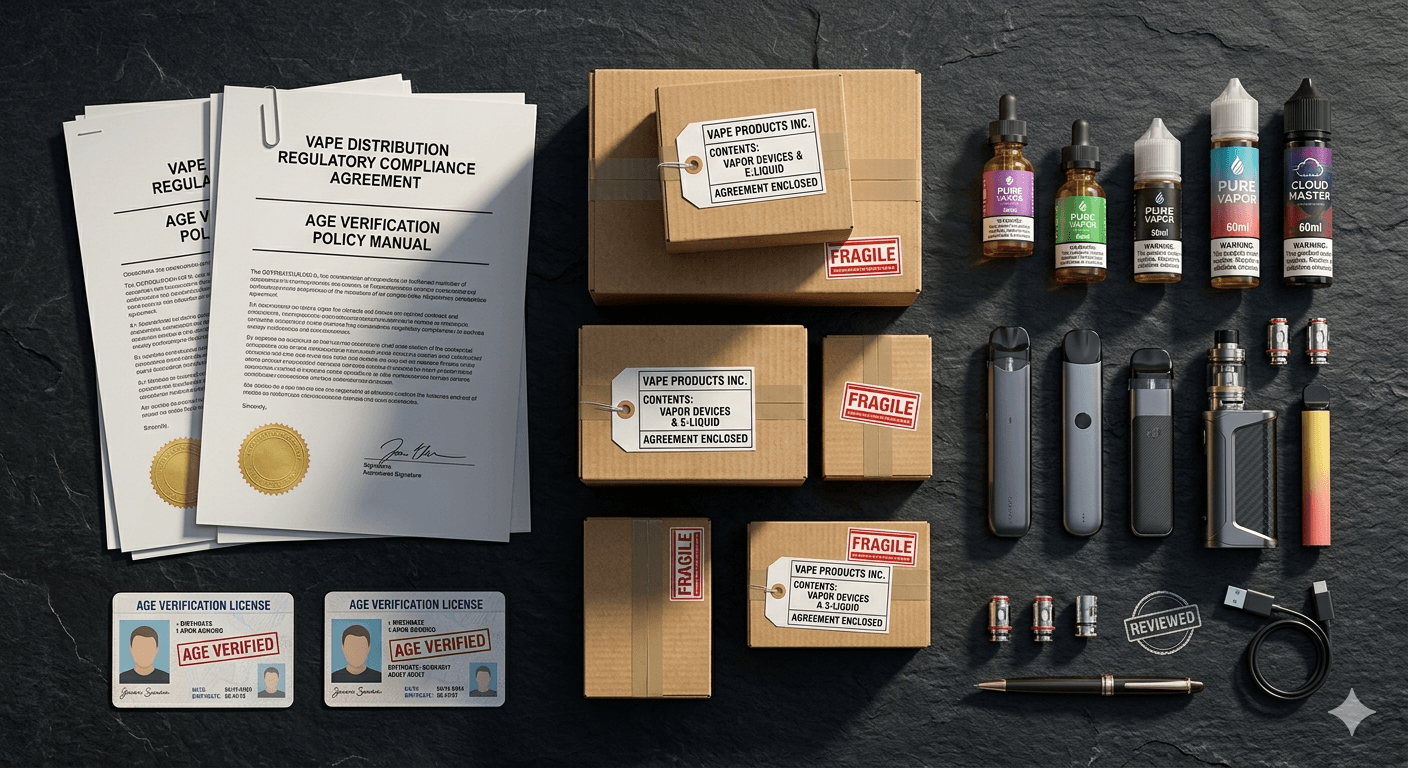
PACT Act Compliance Guide for Smoke Shops & Vape Retailers (2026)
PACT Act compliance for vape shops isn't optional, and enforcement has ramped up significantly since 2021. Whether you sell online, ship to customers, or operate a brick-and-mortar store that takes phone orders, this law likely applies to you.
Here's what you need to know to stay compliant — and out of federal crosshairs.
What Is the PACT Act?
The Prevent All Cigarette Trafficking Act (PACT Act) was originally signed into law in 2010. Its initial purpose was straightforward: stop the sale of untaxed cigarettes through the mail and across state lines. Congress was losing billions in tax revenue from online cigarette sales that skirted state excise taxes.
The original law required anyone selling cigarettes remotely — online, by phone, or by mail — to register with federal and state authorities, pay all applicable taxes, and follow strict shipping rules.
Then came the big change. In December 2020, Congress passed the Preventing Online Sales of E-Cigarettes to Children Act as part of the Consolidated Appropriations Act. This amendment expanded the PACT Act to include all electronic nicotine delivery systems (ENDS) — vapes, e-cigarettes, e-liquids, pods, cartridges, and any component or part of these products.
That single amendment transformed the regulatory landscape for thousands of vape retailers and smoke shops overnight.
Who Does the PACT Act Apply To?
Here's where it gets counterintuitive: the PACT Act doesn't just apply to online retailers. If you've assumed it only affects e-commerce businesses, you're wrong — and you're potentially exposed.
The law applies to any person or business that engages in a "delivery sale" of cigarettes or ENDS products. A delivery sale is any sale where the product is shipped or delivered through a carrier, rather than handed directly to the customer in person at a retail location.
That means the PACT Act covers you if you:
- Sell vape or tobacco products through a website
- Take phone or mail orders and ship products
- Use any delivery service to get products to customers
- Operate as a wholesaler or distributor shipping to retailers across state lines
If every single one of your sales happens face-to-face at your physical shop counter, and you never ship anything, you're generally outside the PACT Act's reach for delivery sale requirements. But you'll still need to comply with the age verification requirements that your state tobacco license mandates.
For wholesale distributors — and there are over 290 listed in the SmokeAxis supplier directory — PACT Act registration is essentially mandatory if you're shipping product across state lines.
Shipping Restrictions Under the PACT Act
This is the section that's cost the most businesses the most money. The shipping rules are strict and, in some cases, absolute.
USPS is completely off the table. As of October 2021, the United States Postal Service will not accept any shipments of cigarettes or ENDS products. Period. No exceptions for business-to-business. No exceptions for small quantities. No exceptions for "samples."
That leaves private carriers — UPS, FedEx, and DHL being the main options. But here's the catch: each carrier has imposed its own restrictions that go beyond what the law requires.
UPS stopped shipping vape products to consumers entirely in April 2021. They do still allow business-to-business shipments between licensed entities in some cases, but the requirements are stringent.
FedEx followed a similar path, halting consumer vape shipments in 2021. Like UPS, limited B2B shipping remains available under specific conditions.
What this means in practice: If you're trying to ship vape products directly to consumers, your options are extremely limited. Most retailers have had to pivot to local delivery services, in-person pickup, or specialized age-verified carriers that have emerged to fill the gap.
Key shipping compliance steps:
- Register with every state you ship into (more on this below)
- Use only carriers that accept ENDS products and have age-verification protocols
- Include required tax stamps and documentation with every shipment
- Never, under any circumstances, use USPS
Age Verification Requirements
The PACT Act requires rigorous age verification for all delivery sales. This isn't a suggestion — it's a federal mandate with teeth.
Before completing any delivery sale, you must:
- Verify the buyer's age using a commercially available database or aggregate of databases. A simple checkbox that says "I am 21 or older" doesn't cut it.
- Use a method approved for delivery sales — this typically means a third-party age verification service that checks government-issued ID data against public records.
- Require an adult signature upon delivery. The person signing must be at least 21, and the carrier must verify their age at the door.
If you're running a physical store, you're already checking IDs at the counter. But if you also do any kind of delivery — even local delivery within your own city — these federal requirements apply.
The cost of third-party age verification services typically runs between $0.25 and $2.00 per transaction, depending on volume. It's a small price compared to the penalties below.
Record-Keeping Obligations
This is the part most shops skip — and it's the part that makes audits devastating.
The PACT Act requires you to maintain detailed records of every delivery sale for a minimum of four years . These records must include:
- Buyer's full name and address
- Date of sale and date of delivery
- Quantity and type of product sold
- Method of age verification used
- Proof that applicable state and local taxes were paid or collected
You must also file monthly reports with the tax administrator of every state and every Indian tribe into which you ship products. These reports must include the name, address, and phone number of each buyer, along with the brand, quantity, and date of each sale.
Additionally, you're required to register with the ATF and with the tobacco tax administrators of every state where you make delivery sales. Registration must happen before you start selling into a state — not after.
If you're selling into 15 states, that's 15 separate state registrations, 15 monthly reports, plus your federal ATF registration. The administrative burden is real, which is why many smaller shops have stopped shipping altogether and focused on in-store sales.
Penalties for Non-Compliance
Here's where the PACT Act gets serious. The penalties aren't slaps on the wrist.
Criminal penalties: Violating the PACT Act is a federal crime. Individuals can face up to three years in prison for a first offense.
Civil penalties: Fines of up to $250,000 per violation for businesses. Each individual shipment can constitute a separate violation, so the math gets ugly fast. Ship 100 non-compliant packages? That's theoretically up to $25 million in exposure.
Asset forfeiture: The federal government can seize any cigarettes or ENDS products involved in a violation, plus any property used to facilitate the violation — including vehicles and equipment.
State-level consequences: On top of federal penalties, states can pursue their own enforcement actions for unpaid excise taxes, which often include the tax owed plus penalties of 25-100% of the unpaid amount, plus interest.
In practice, most first-time violations result in cease-and-desist orders and fines in the $10,000–$50,000 range. But repeat offenders and large-scale violators have seen the full weight of these penalties applied.
What Changed in Recent Years
The 2020 amendment was the watershed moment. Before it, vape products existed in a regulatory gray area under the PACT Act. After it, they were explicitly covered.
Here's a timeline of the major changes:
2010: Original PACT Act signed into law, covering cigarettes and smokeless tobacco.
December 2020: The Preventing Online Sales of E-Cigarettes to Children Act expands the PACT Act to include all ENDS products — effective March 27, 2021.
March 2021: USPS publishes final rule implementing the ENDS shipping ban.
April–June 2021: UPS and FedEx voluntarily stop shipping vape products to consumers.
2022–2025: Enforcement actions increase. The ATF and state attorneys general begin pursuing cases against non-compliant online vape retailers. Several high-profile cases result in six-figure fines.
2026: The enforcement environment remains active. States are increasingly using the PACT Act's reporting requirements to identify retailers who aren't collecting excise taxes.
The practical impact has been enormous. Thousands of online vape shops closed or went underground. Legitimate retailers who adapted are now operating in a less crowded market — which is the counterintuitive upside. Compliance became a competitive advantage. If you're one of the shops that did the work, you're competing against fewer players.
How the PACT Act Interacts with State Laws
Federal law sets the floor, not the ceiling. States can — and do — add their own requirements on top of the PACT Act.
This creates a patchwork that's genuinely difficult to manage if you're shipping across state lines. Here's how four major markets handle it:
California has some of the strictest tobacco and vape regulations in the country. Beyond PACT Act compliance, you'll need California-specific retail licenses and must comply with flavored tobacco product restrictions under Proposition 31. If you're shipping into California, expect additional reporting requirements. See our full breakdown of California smoke shop license requirements.
Texas requires a separate state-level permit for ENDS product sales and has its own excise tax structure for vapor products. Texas has been active in enforcing PACT Act reporting requirements, using the data to pursue tax collection. Read more about Texas smoke shop licensing.
Florida imposes its own delivery sale restrictions and requires retailers to register with the Division of Alcoholic Beverages and Tobacco. Florida's ENDS tax structure, implemented in recent years, adds another compliance layer. Our Florida smoke shop license guide covers the details.
New York has arguably the most aggressive enforcement posture of any state. New York's tax rates on vapor products are among the highest in the nation, and the state actively pursues PACT Act violators through its Department of Taxation and Finance. Get the full picture in our New York smoke shop license guide.
The bottom line: if you ship into multiple states, you need state-by-state compliance. There's no shortcut. Many retailers use compliance consultants or software that costs between $200 and $500 per month to manage multi-state obligations.
How to Stay Compliant: A Practical Checklist
Knowing the rules is one thing. Here's what to actually do:
- Register with the ATF using Form 5070.1. It's free and takes roughly 2-4 weeks to process.
- Register with every state where you make or plan to make delivery sales. Check each state's tobacco tax administrator website for specific forms.
- Stop using USPS immediately for any tobacco or ENDS shipments.
- Implement a third-party age verification service for all online and delivery orders.
- Set up your record-keeping system to capture all required data points for four years.
- File monthly reports with each state's tax administrator.
- Collect and remit all applicable excise taxes for every state you ship into.
- Review your shipping carriers' current policies — they change frequently.
- Consult with a tobacco compliance attorney if you're shipping into more than five states.
If you're just starting a new smoke shop, build PACT Act compliance into your business plan from day one. Retrofitting compliance after you've been operating non-compliantly is far more expensive and stressful.
Frequently Asked Questions
Does the PACT Act apply to CBD or hemp products?
The PACT Act specifically covers tobacco products and ENDS (electronic nicotine delivery systems). CBD and hemp products that don't contain nicotine or tobacco generally fall outside its scope. However, if a product contains nicotine derived from any source — including synthetic nicotine — it may be covered.
Can I ship vape products through USPS if it's business-to-business?
No. The USPS ban on mailing ENDS products applies to all shipments, regardless of whether they're B2B or B2C. There are extremely narrow exceptions for certain regulatory and public health purposes, but standard commercial shipments are prohibited.
Do I need to register with the ATF if I only sell in-store?
If all your sales are face-to-face at your physical retail location and you never ship product, you're generally not required to register under the PACT Act's delivery sale provisions. However, you still need all applicable federal, state, and local retail licenses. Check our tobacco retail license guide for what's required.
What carriers still ship vape products?
UPS and FedEx have largely exited consumer vape shipping but may allow B2B shipments between licensed businesses under strict conditions. A handful of specialized carriers and regional delivery services have emerged to fill the gap. Contact carriers directly for their most current policies, as they change frequently. Finding reliable wholesale distributors who handle compliant shipping can simplify this significantly.
How often does the ATF audit PACT Act compliance?
The ATF doesn't publish a set audit schedule. Enforcement actions are typically triggered by complaints, state referrals, or data analysis showing discrepancies between reported sales and tax collections. That said, enforcement has increased substantially since 2021, and the ATF has dedicated additional resources to PACT Act compliance. Operating as though an audit could happen any time is the safest approach.
This guide is for informational purposes only and does not constitute legal advice. Tobacco and vape regulations change frequently at the federal, state, and local level. Always consult with a qualified attorney or compliance professional before making business decisions based on this information. SmokeAxis makes no guarantees about the accuracy or completeness of regulatory information. For the most current requirements, visit the ATF website and your state's tobacco tax authority.
Last reviewed: April 2026