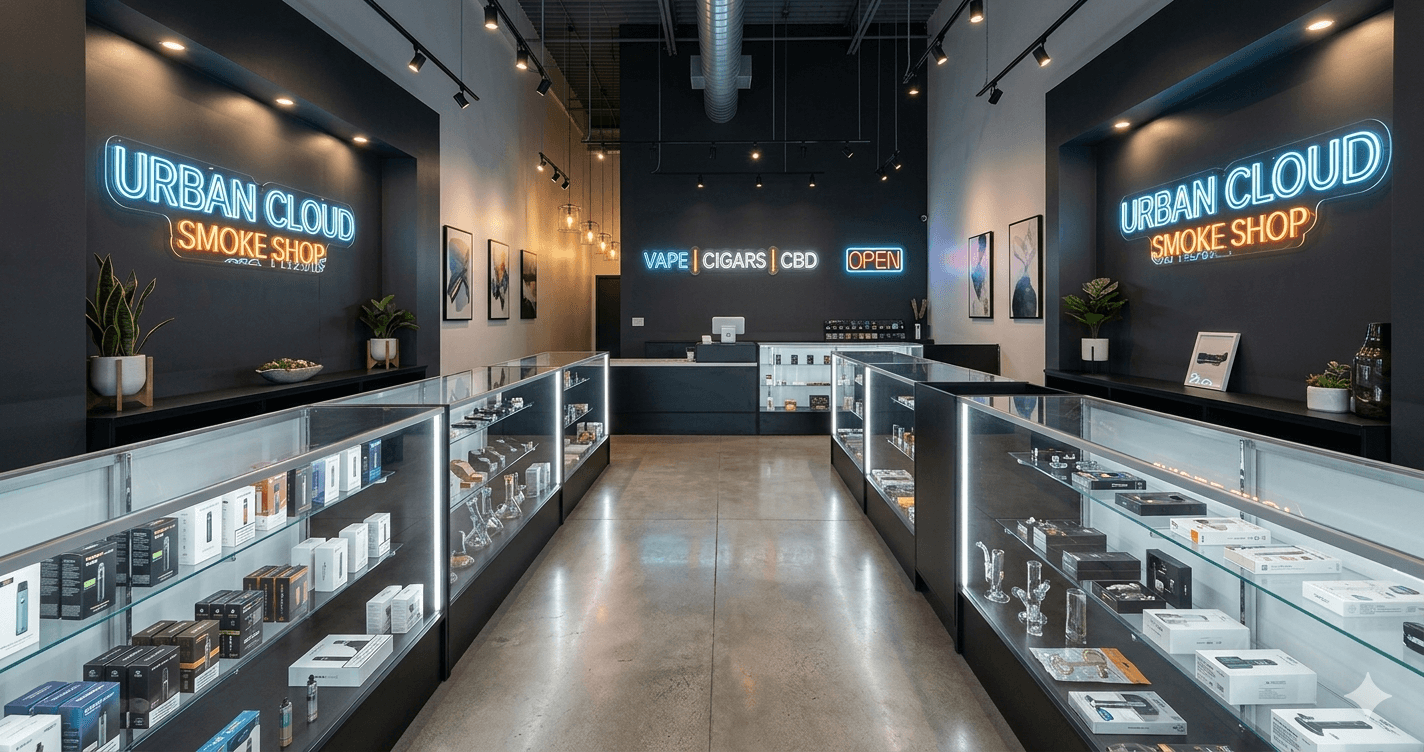
How to Open a Smoke Shop: Complete 2026 Guide
The US tobacconist industry — smoke shops and tobacco stores — generated $21.5 billion in revenue in 2025, roughly flat year-over-year after several years of rapid growth, according to IBISWorld's 2025 Tobacconists industry report. But the difference between shops that thrive and shops that close within 18 months almost always comes down to what happens before the doors open.
This guide walks you through every step of how to open a smoke shop in 2026 — from the licenses you'll need to the suppliers who'll keep your shelves stocked. No fluff, just the stuff that actually matters.
Assess the Market Before You Spend a Dollar
Skip this step and you're gambling. Do it well and you'll know exactly what your local market wants before you sign a lease.
Start by counting. How many smoke shops already operate within a 5-mile radius of your target area? Drive to each one. Walk in. Look at what they stock, what they're missing, and how busy they are on a Tuesday afternoon. A saturated market doesn't mean you can't compete — it means you need a sharper angle.
Check your city's demographic data. College towns skew toward vape products and glass. Suburban areas lean toward premium cigars and CBD. Rural markets often have less competition but lower foot traffic, which means your average transaction needs to be higher to compensate.
Here's something most guides won't tell you: opening near a cannabis dispensary can actually help your business. In states with legal recreational cannabis, dispensaries drive steady foot traffic from your exact target customer. Shops near dispensaries can pick up real spillover walk-ins, though how much varies block by block. The key is stocking complementary products they can't get at the dispensary — rolling papers, grinders, high-end glass, storage solutions.
Talk to at least 10 potential customers. Not friends and family. Actual people who buy smoke shop products. Ask them what their current shop gets wrong. Their answers will shape your inventory and positioning better than any market report.
Licensing and Permits: The Non-Negotiable Foundation
Getting your licenses wrong can get your shop shut down, your inventory seized, or land you with fines that eat your startup capital. This is the part you don't cut corners on.
Federal requirements come first. If you're selling any tobacco products, you need to register with the FDA as a tobacco retailer. It's free, but it's mandatory. You'll also need a federal Employer Identification Number (EIN) from the IRS if you're forming an LLC or corporation.
State tobacco licenses vary wildly. In California, a tobacco retail license costs $450 per location per year (as of July 1, 2026); in New York, it's about $300 per location. Some states require separate licenses for cigarettes versus other tobacco products, and a handful (Michigan, Missouri, Tennessee) don't license retail tobacco at the state level at all. Check your state's Department of Revenue, Tax Commission, or ABC board — they handle tobacco licensing in most states.
Local permits are where it gets complicated. You'll typically need:
- A general business license from your city or county ($50-$500)
- A sales tax permit from your state
- A Certificate of Occupancy for your retail space
- A fire department inspection certificate
- Possibly a special use permit if your zoning has restrictions on tobacco retail
Some cities have started capping the number of tobacco retail licenses or setting minimum distance requirements between smoke shops (often 500-1,000 feet). San Francisco, for example, has frozen new tobacco retail permits in several neighborhoods. Research your local rules early — before you sign a lease, not after.
CBD and hemp products add another layer. If you plan to stock CBD (and you should — margins are strong), confirm your state allows retail CBD sales and understand any additional licensing. Most states require CBD products to contain less than 0.3% THC and come with certificates of analysis from third-party labs. Connect with reputable wholesale suppliers who provide proper documentation for every product they ship.
Timeline: Budget 4-8 weeks for licensing. Some states process applications in days; others take months. Don't assume you'll be fast-tracked.
Choosing the Right Location
Location will be your single largest ongoing expense, and more than any other decision it determines your walk-in traffic. Get this wrong and no amount of marketing will save you.
Rent expectations: For a 800-1,500 square foot retail space, you're looking at $2,000-$5,000/month depending on the market. Strip malls and standalone retail in mid-tier cities average $2,500-$3,500. High-traffic urban locations can run $4,000-$7,000.
But here's what matters more than the rent number: cost per walk-in. A $4,500/month location that gets 80 walk-ins per day is a far better deal than a $2,200/month spot that gets 15. Always calculate your rent as a ratio of foot traffic.
Visibility from the road matters enormously. A shop tucked behind a building or on the second floor of a strip mall will struggle no matter how good your products are. You want a ground-floor space with clear signage visibility from the main road. Bonus if there's a traffic light nearby — stopped cars read signs.
Parking is non-negotiable. Your customers are making quick stops. If parking is a hassle, they'll go to the shop that's easier to get in and out of. Four to six dedicated spots minimum.
Look for locations near complementary businesses: gas stations, convenience stores, liquor stores, dispensaries, tattoo shops. These share your customer base without directly competing. Avoid spots next to schools, churches, or daycare centers — most local ordinances prohibit tobacco retail within a certain distance (typically 500-1,000 feet), and even where it's legal, it's bad optics.
Lease negotiation tips: Push for a 3-year lease with a 2-year renewal option. Ask for 2-3 months of free rent as a build-out period — most landlords expect this for retail tenants. Get any verbal promises about signage, parking, or exclusivity clauses in writing.
Startup Costs: A Realistic Breakdown
Forget the "$10,000 to start a smoke shop" claims you'll see online. Those numbers are fantasy. Here's what it actually costs to open a properly stocked, code-compliant smoke shop in 2026.
Low-end estimate (small market, 800 sq ft): $50,000-$75,000
Mid-range estimate (average market, 1,200 sq ft): $75,000-$120,000
High-end estimate (competitive urban market, 1,500+ sq ft): $120,000-$150,000+
Here's where that money goes:
Lease and deposits: $6,000-$15,000. Expect first month, last month, and a security deposit equal to one month's rent. Some landlords want three months' security for new businesses without a track record.
Build-out and fixtures: $10,000-$30,000. Display cases ($3,000-$8,000), shelving ($1,500-$4,000), lighting ($1,000-$3,000), flooring ($2,000-$5,000), signage ($1,500-$4,000), security system and cameras ($1,500-$3,000), POS system ($500-$2,000). The display cases are where you don't want to go cheap — they're the first thing customers see and they protect your most expensive inventory.
Initial inventory: $15,000-$40,000. This is your biggest variable. A shop focused on vapes and disposables can stock leaner. A full-service shop carrying glass, tobacco, CBD, accessories, and vapes needs a deeper investment. More on this in the next section.
Licensing and legal: $1,500-$7,000. Varies dramatically by state. Include the cost of forming your LLC ($100-$500) and a consultation with a business attorney who knows tobacco retail ($500-$1,500).
Insurance: $1,200-$3,000/year. General liability is mandatory. You'll also want property insurance covering your inventory and business interruption coverage.
Working capital: $10,000-$20,000. This is the money that keeps you alive for the first 3-6 months while you build your customer base. Covers rent, utilities, payroll, and restock orders before revenue stabilizes. Most new shop owners underestimate this line item, and it's the one that sinks them.
Marketing launch: $2,000-$5,000. Grand opening promotion, initial social media ads, Google Business Profile setup, local SEO, signage, and flyers.
If you're financing, expect to put 20-30% down. SBA microloans and community development financial institutions (CDFIs) are more friendly to retail tobacco businesses than traditional banks, which sometimes have policies against lending to tobacco-related businesses.
Building Your Initial Inventory
Your opening inventory sets the tone for your shop. Stock too narrow and customers write you off after one visit. Stock too broad and your cash is tied up in slow-moving products collecting dust.
The 60/30/10 rule works well for new shops: 60% of your inventory budget on proven sellers (disposable vapes, popular e-liquids, rolling papers, lighters), 30% on mid-tier products that differentiate you (premium glass, CBD products, specialty accessories), and 10% on high-margin specialty items that create buzz (artisan pieces, limited runs, trending brands).
Disposable vapes and e-cigarettes are your volume drivers right now. The disposable vape market has exploded, and these products turn fast with solid margins (typically 40-60% markup at retail). Work with established disposable vape wholesalers who can guarantee authentic products and consistent supply. Counterfeits are rampant in this category — buy from verified distributors only.
Glass pipes and water pipes are where you build margin and reputation. A well-curated glass selection signals to customers that your shop is serious. Entry-level pieces ($15-$40 retail) move in volume. Mid-range pieces ($50-$150) are your sweet spot for margin. Showcase pieces ($200+) are more about branding than revenue — they draw eyes and Instagram posts. Source from reputable glass pipe distributors who offer both domestic and import options.
Tobacco products — cigarettes, cigars, pipe tobacco, rolling tobacco — carry thinner margins (typically 15-25%) but drive repeat visits. Cigarette customers come in daily. They'll pick up impulse items on every trip if your checkout area is merchandised properly.
CBD and hemp products deserve serious shelf space in 2026. Gummies, tinctures, topicals, and pre-rolls all perform well in smoke shop settings. Margins are excellent (often 50-70% markup), and the customer base overlaps heavily with your core traffic. Just make sure every product comes with a certificate of analysis.
Accessories — grinders, rolling trays, storage containers, torches, cleaning supplies, scales, odor eliminators — are low-cost, high-margin fillers that round out baskets. Don't overlook them.
For your first order, resist the urge to go deep on any single SKU. Order smaller quantities across more products. You'll learn what your specific market wants within the first 60-90 days, and then you can double down on winners and cut the dead weight.
Finding Wholesale Suppliers Who Won't Waste Your Time
Your suppliers will make or break your margins, your inventory freshness, and your ability to stock what customers actually want. Choosing the right wholesale partners is one of the most important decisions you'll make.
Start by understanding the supplier landscape. You've got national distributors who carry everything, regional specialists who focus on specific categories, and direct-from-manufacturer brands. Most successful shops work with 4-6 suppliers to balance selection, pricing, and reliability.
What to look for in a wholesale supplier:
Price matters, obviously. But consistency matters more. A supplier who's 5% cheaper but frequently out of stock on your top sellers will cost you more in lost sales than you'll ever save on wholesale pricing. Prioritize suppliers with strong fill rates (95%+ of your order ships complete) and fast turnaround (2-5 business days).
Minimum order requirements vary. Some distributors set $200 minimums, others want $1,000+. For a new shop, start with suppliers who have lower minimums so you can test products without overcommitting capital.
Ask about return policies and defect handling. Glass breaks in shipping. Vape products occasionally arrive defective. A good supplier handles these situations quickly and without hassle.
You can browse verified wholesale distributors across all 14 wholesale product categories to compare options. If you're in a specific state, filtering by location helps — Texas wholesale suppliers and Florida-based distributors are popular starting points, but there are reliable suppliers in every region.
For a deeper breakdown of vetting and comparing distributors, read our guide to finding wholesale suppliers. It covers negotiation tactics, red flags to watch for, and how to set up accounts with multiple distributors without overextending your budget.
Negotiation tips for new shops: Most wholesale reps have flexibility on pricing, especially for opening orders. Ask for a new-customer discount (10-15% off your first order is common). Request net-30 payment terms — many distributors offer them after your first or second prepaid order. And always ask if there are volume break points you're close to hitting.
Build relationships with your reps. Call them, don't just email. A rep who knows your name and your store will tip you off about closeout deals, new product launches, and incoming price increases before they hit.
Staffing Your Smoke Shop
Most new smoke shops start with the owner plus one or two part-time employees. That's usually enough for a shop that's open 10-12 hours a day, six or seven days a week.
Hire for product knowledge and personality — you can teach the register, but you can't teach someone to genuinely connect with customers. Your employees are your brand. A bored cashier scrolling their phone costs you repeat business every single day. A knowledgeable, friendly employee who can recommend the right product builds loyalty that no marketing campaign can match.
Pay expectations in 2026: Smoke shop employees typically earn $14-$18/hour depending on the market. Managers or lead employees run $18-$22/hour. Some shops add commission on high-margin products (glass, CBD, premium vapes) to incentivize upselling — even 2-3% commission can noticeably boost average ticket sizes.
Age requirements matter. Federal law requires that anyone selling tobacco products be at least 18. Many states set the bar at 21 for employees who handle tobacco sales. Verify your state's rules before you hire.
Train your staff on ID verification — the penalties for selling to minors are severe. Fines start at $11,000 for a first offense under federal law, and repeated violations can result in losing your tobacco license entirely. Use a strict "card everyone under 30" policy and consider an electronic age verification system at the register.
Scheduling: Your busiest hours are typically 11 AM - 2 PM and 4 PM - 7 PM on weekdays, with Saturdays being your highest-volume day. Staff accordingly. Don't waste payroll on slow mornings with two people behind the counter.
You don't need a huge team early on. Work the counter yourself for the first few months. You'll learn your customers, understand your traffic patterns, and figure out exactly what kind of help you need before spending on it.
Marketing Your New Smoke Shop
You've got the location, the inventory, and the staff. Now people need to know you exist. Marketing a smoke shop has unique constraints — most major ad platforms restrict tobacco-related advertising — but there are plenty of effective channels that work.
Google Business Profile is your single highest-ROI marketing move. It's free, and it puts you in front of people actively searching for smoke shops near them. Fill out every field. Upload 20+ high-quality photos of your store, your products, and your displays. Post weekly updates. Respond to every review. Review count is a gate for shoppers: in BrightLocal's 2026 Local Consumer Review Survey, 47% of consumers said they won't use a business with fewer than 20 reviews.
Local SEO extends beyond Google. Get listed in online directories, including wholesale and industry-specific directories. Make sure your name, address, and phone number are identical everywhere. Inconsistencies confuse search engines and customers alike.
Social media works, but selectively. Instagram is your best platform — smoke shop products are visual. Showcase new arrivals, glass art, store displays, and behind-the-scenes content. TikTok can drive massive awareness for shops that create entertaining content. Facebook is useful for local community groups and event promotion. Don't bother with Twitter/X — the ROI for local retail is negligible.
Be careful with platform rules. Instagram and TikTok prohibit direct tobacco advertising, but they allow content about your store, your products (framed as lifestyle or art), and your community involvement. Focus on building a following around your shop's vibe, not pushing individual products.
Grand opening event: Make it memorable. Partner with local food trucks or DJs. Offer opening-week specials (buy-one-get-one on accessories, discounts on first purchases over $50). Invite neighboring businesses. First impressions set your reputation in the community for months.
Loyalty programs drive repeat business better than almost anything else. A simple punch card (buy 10 packs, get one free) or a digital loyalty system keeps customers coming back to your shop instead of the competitor down the road. The cost is minimal and the retention impact is measurable within the first month.
Community involvement builds long-term credibility. Sponsor a local sports team. Participate in neighborhood events. Partner with nearby businesses for cross-promotions. Being seen as part of the community — not just another shop extracting money from it — creates a moat that online competitors and new entrants can't easily replicate.
Budget allocation for your first year: Put 60% of your marketing budget into digital (Google Business Profile optimization, local SEO, social media content), 25% into in-store marketing (signage, displays, loyalty program setup), and 15% into community and event marketing.
Operational Tips for Your First Year
The first year is about survival and learning. Your job is to stay open long enough to figure out what works in your specific market.
Track everything from day one. Daily sales by category, average transaction size, peak hours, top-selling SKUs, and slow movers. Most POS systems generate these reports automatically. Review them weekly. Data-driven decisions separate shops that scale from shops that stagnate.
Reorder timing is a skill you'll develop. Run out of a top seller and you lose sales and customer trust. Overstock and your cash is trapped in inventory. A good rule of thumb: reorder when you have two weeks of supply left on fast movers, and four weeks on slower items. Adjust these thresholds as you learn your actual sell-through rates.
Shrinkage (theft) is real. Smoke shops are frequent targets for both shoplifting and employee theft. Keep high-value items in locked display cases. Install visible security cameras. Conduct regular inventory counts — monthly at minimum. Retail shrink averaged 1.6% of sales industry-wide in 2022, per the National Retail Federation's National Retail Security Survey (2023) — and small-format stores full of pocketable, high-value product sit on the exposed end of that curve.
Adapt fast. The products that sell well in month one won't necessarily be your top sellers in month six. Vape trends shift quickly. New brands emerge. Regulations change. Stay plugged into industry news and be willing to pivot your inventory mix based on what the data tells you.
Cash flow management is more important than profit in year one. A shop can be profitable on paper and still close because it can't cover next month's rent and restock order. Keep a minimum cash reserve of two months' fixed expenses at all times. If that buffer shrinks, cut discretionary spending immediately — don't wait and hope next week will be better.
FAQ
How much does it cost to open a smoke shop?
Expect to invest $50,000-$150,000 depending on your market size, location, and how much inventory you want to carry at launch. The biggest line items are initial inventory ($15,000-$40,000), lease deposits and build-out ($16,000-$45,000), and working capital reserves ($10,000-$20,000). Undercapitalizing is the most common reason new smoke shops fail within the first year.
How profitable is a smoke shop?
Smoke shops sold on BizBuySell between 2021 and 2025 reported a median of $420,000 in annual revenue and $100,000 in owner earnings. Margins vary by product category — glass and CBD products can hit 50-70% gross margin, while cigarettes and tobacco typically run 15-25%. The key to profitability is balancing high-volume, low-margin traffic drivers with high-margin specialty products.
Do I need a special license to sell vapes and e-cigarettes?
Yes. The FDA regulates e-cigarettes and vape products as tobacco products. You'll need the same federal tobacco retailer registration required for cigarettes, plus your state tobacco license typically covers vape products. Some states and cities have additional vape-specific regulations, including flavor bans and display restrictions. Check your state and local laws — they're changing frequently.
Can I open a smoke shop with no experience?
You can, but expect a steeper learning curve. Spend at least 2-3 months before opening visiting other shops, attending a wholesale trade show (like the Tobacco Plus Expo), and building relationships with distributors. Working part-time at an existing smoke shop for even a few weeks will teach you more about operations, customer preferences, and product knowledge than months of online research.
How do I find reliable wholesale suppliers?
Start by searching industry directories where distributors are vetted and categorized by product type and location. You can browse verified wholesale distributors to compare options across vape, glass, CBD, tobacco, and accessories categories. Order samples before committing to large quantities, and always verify that vape and CBD suppliers provide proper lab testing documentation and compliance paperwork.
Ready to start sourcing inventory for your new shop? Browse verified wholesale distributors across every product category and connect directly with suppliers who specialize in serving smoke shops and vape stores. Your first wholesale order is closer than you think.