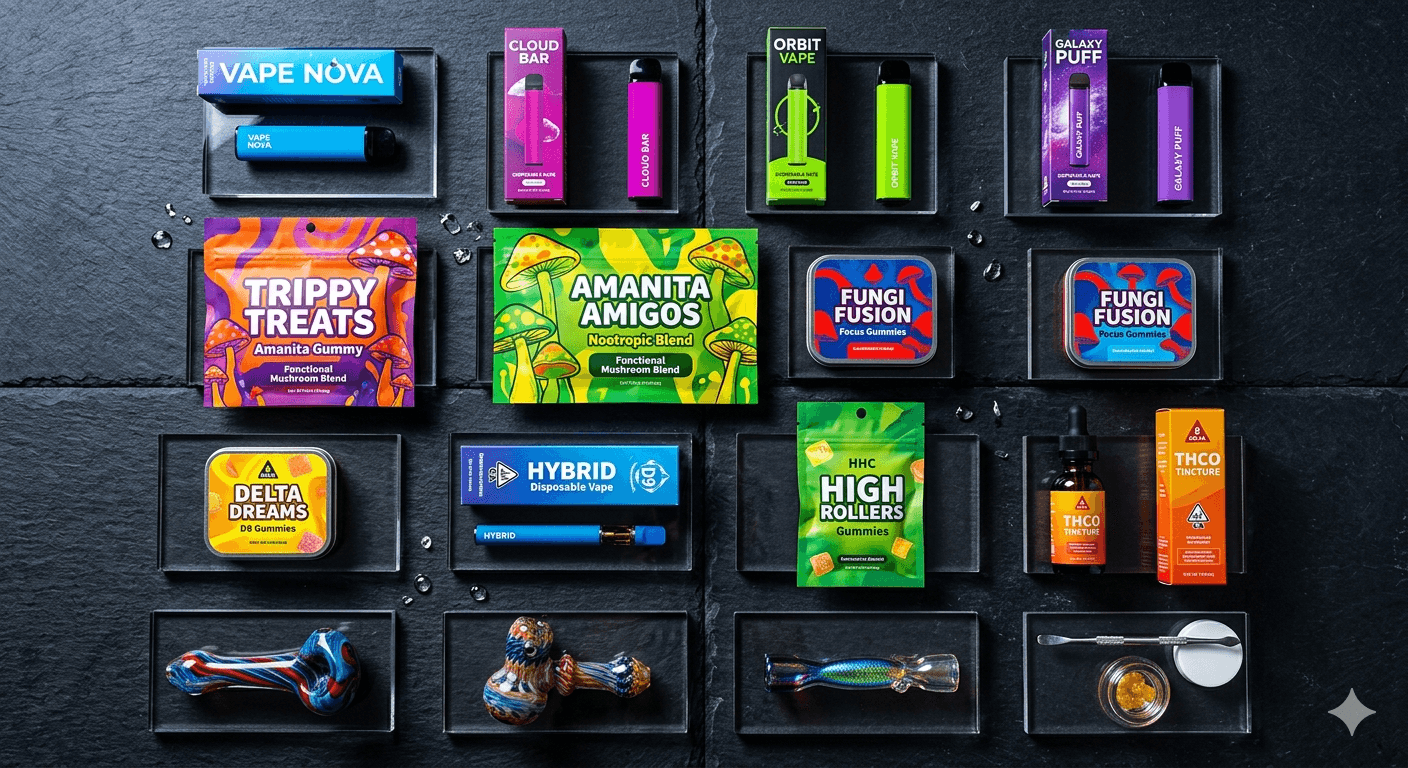
Trending Smoke Shop Products in 2026: What's Selling Right Now
The smoke shop product mix moves faster than almost any other corner of retail. Categories that dominated two years ago are giving up shelf space to products that barely existed back then — and some of last year's best sellers are now heading toward outright bans. Keeping track of what's actually trending in 2026 isn't optional anymore: the shops that stock the right mix protect their margins, while the ones clinging to last year's planogram watch customers walk across the street.
Here's what's genuinely moving off shelves right now, what's fading, and which categories to wind down before the rules change — so you can position your store for what's coming next.
Top Trending Product Categories in 2026
The product mix in a typical smoke shop looks nothing like it did even three years ago. Here are the categories shaping the smoke shop mix this year:
- Disposable vapes — still the volume king, but the landscape is shifting fast
- Alt cannabinoids — delta-8, THCa, and HHC still sell where they're legal, but a federal hemp redefinition on November 12, 2026 is pulling the category off shelves nationwide — wind this down, don't build it
- Functional mushroom products — strong shopper interest, but a category SmokeAxis no longer lists wholesalers for, and one where "mushroom gummy" can mean psychoactive amanita muscaria
- Premium rolling accessories — flavored cones, hemp wraps, and branded kits
- Nicotine pouches — steadily climbing as more smokers look for alternatives
The biggest shift has been functional mushrooms, which moved from a niche health-food-store item to a common smoke shop product in just a couple of years. It's not a category to chase blindly, though: as the section below explains, the "mushroom gummy" label covers both benign supplements and psychoactive amanita muscaria, and SmokeAxis no longer lists wholesalers for it.
Disposable Vape Trends: What's Hot, What's Shifting
Disposable vapes aren't going anywhere. They're still the anchor revenue category at most smoke shops. But the category itself is evolving quickly.
What's selling right now
Higher-puff-count devices are dominating. The 5,000-puff models that were popular in 2024 have given way to 10,000-15,000 puff devices with rechargeable batteries and digital screens. Customers want fewer trips to the store, and these devices deliver.
Nicotine salt formulas at lower strengths (3-5mg) are trending up. The high-nic rush is cooling off, and many customers are stepping down gradually. Smart shops stock the full strength range.
Brand consolidation is happening. A few major brands now account for the bulk of sales. If you're stocking 15 different disposable brands, you're probably carrying too many. Focus on the top 5-6 that your customers actually ask for and you'll free up shelf space for higher-margin products.
The regulatory wildcard
The FDA's enforcement posture on disposables continues to tighten. Several popular brands have received marketing denial orders, and more are expected. This doesn't mean the category is dying — far from it. But it does mean you need reliable disposable vape wholesalers who can pivot quickly and keep you stocked with compliant products.
Takeaway: Stock disposables deep, but narrow your brand selection. Watch the FDA pipeline closely and have backup suppliers ready.
Alt Cannabinoids: Why Delta-8, THCa, and HHC Are Winding Down
Alt cannabinoids grew fast after the 2018 Farm Bill opened the door, but 2026 is the turning point. A federal hemp redefinition and a wave of state bans are pulling most of this category off the shelf — so the story now is how to wind it down, not build it up.
What's still selling
THCa flower and pre-rolls are still the highest-volume segment. THCa converts to THC when heated, giving customers a familiar experience while technically falling under the hemp-derived umbrella in many states — which is exactly what the federal redefinition below targets. Margins have historically been healthy, but that math only holds while the product is legal to stock.
Delta-8 edibles remain strong sellers. Gummies in particular move consistently, with price points typically between $15-30 at retail. They're accessible, approachable, and attract a broader customer base than smokable products.
HHC products have found a stable niche. They're not growing as fast as THCa, but they've got a loyal customer base that appreciates the slightly different effect profile.
The legal patchwork
For a while, state-level bans even helped shops in neighboring legal states — restrictions in one state pushed cross-border traffic to the next. That arbitrage is closing: the federal redefinition applies everywhere at once, so there's no neighboring legal market left to absorb the demand.
That said, this category is contracting fast, and you need to track the law before committing a dollar to it. A growing number of states have restricted alt cannabinoids, and California and Ohio have banned them outright. The decisive change is federal: Public Law 119-37 §781 redefines hemp effective November 12, 2026, pushing most intoxicating hemp-derived cannabinoids — delta-8, delta-10, HHC, THC-P — out of the federal hemp definition nationwide. This is not a category to build or expand into now. If you still carry these products, treat the months ahead as a sell-down-and-exit window and plan the shelf space for categories that will outlast the deadline.
Takeaway: This is a contracting, high-risk category with a hard federal deadline on November 12, 2026. If you still carry THCa or other alt cannabinoids, sell through what you have, keep third-party COAs on every batch, and don't reorder into the deadline.
Mushroom Products: Functional Supplements — and the Amanita Question
Let's be clear upfront: the legitimate version of this category is legal, functional mushroom products — lion's mane, reishi, cordyceps, chaga — adaptogenic mushrooms sold as supplements, gummies, tinctures, and drink mixes. Not psilocybin, and not amanita muscaria either — a psychoactive mushroom often sold under the same "mushroom gummy" label, which we flag below.
Why smoke shops?
Smoke shops have become the go-to retail channel for functional mushrooms, and it makes sense. Your customer base already skews toward wellness-curious adults who are comfortable buying ingestible products outside of traditional pharmacies and grocery stores.
Margins have been part of the draw — functional mushroom gummies have carried a healthy retail markup over wholesale. But the label "mushroom gummy" now covers two very different products, and that distinction matters more than the margin.
What's moving
Functional mushroom gummies (lion's mane, reishi) are familiar, thanks to the CBD gummy craze, and easy to merchandise. Amanita muscaria gummies are a different product entirely — psychoactive, sold for their intoxicating effect. Louisiana bans amanita's active compounds, muscimol and ibotenic acid (La. R.S. 40:989.5), and is currently the only state to do so; everywhere else the product is largely unregulated. If you stock anything labeled "mushroom gummy," know which one you're actually buying, check your state's law, and get a COA that identifies the active compounds.
Mushroom + caffeine blends are a growing sub-category. Think focus and energy formulas combining lion's mane with natural caffeine. They attract a slightly different customer than your typical smoke shop buyer, which is a good thing — it broadens your traffic.
Tinctures and capsules sell steadily but slower. They appeal to repeat buyers who've already been converted through gummies.
SmokeAxis no longer maintains a wholesale directory for mushroom products, so we're not pointing shop owners toward building this category out here. If you already carry functional mushroom supplements, source them directly and confirm each product's contents — especially given the amanita ambiguity above.
Takeaway: Functional mushrooms (lion's mane, reishi) remain legal supplements, but SmokeAxis no longer lists wholesalers for the category, and anything labeled "mushroom gummy" needs to be checked for amanita muscaria — psychoactive and already banned in Louisiana. Source directly, verify contents, and follow your state's rules.
What's Declining: Products Losing Shelf Space
Not everything is trending up. Here's what shop owners are telling us is losing momentum:
CBD tinctures and oils
This one stings because CBD was the growth story of 2019-2022. But the market is saturated, customer interest has plateaued, and margins have compressed. CBD isn't dead — it's just not growing. Most shops are cutting back their CBD assortments and reallocating that shelf space to alt cannabinoids and mushroom products.
Basic glass pipes
The bottom end of the glass market is getting squeezed. Cheap spoon pipes and basic chillums that used to be impulse buys now compete with gas stations and convenience stores. If you're still dedicating a full display case to sub-$15 glass, consider trimming it and moving upmarket with mid-range and artisan pieces that carry better margins.
Traditional tobacco accessories
Rolling papers still sell, but traditional tobacco-adjacent products like cigarette cases, basic lighters (non-branded), and pipe tobacco accessories are in slow decline. They're not worth removing entirely — they don't take up much space — but don't reorder aggressively.
Kratom (in some markets)
This one's market-dependent. In states with favorable regulations, kratom remains solid. But in states where bans are pending or the regulatory environment is uncertain, some shops are pulling back. Watch your local situation closely.
Takeaway: Audit your shelf space quarterly. Every square foot that holds a declining product is a square foot that could hold a growing one.
How to Stay Ahead of Trends
Spotting trends early is worth real money. Here's how the smartest shop owners stay ahead:
Watch your own data first
Your POS system is your best trend indicator. Look at 90-day velocity by SKU. Products accelerating in sales volume over three consecutive months are your signal to stock deeper. Products decelerating need to be put on notice.
Build relationships with multiple suppliers
The shops that catch trends early usually have relationships with 4-6 different wholesale suppliers across categories. They're hearing about new products before they hit mainstream distribution. Browse the SmokeAxis supplier directory to find distributors who specialize in emerging categories.
Follow the regulation calendar
Regulatory changes create both risk and opportunity. When a state bans a product, something else fills the demand. When a product gets FDA clearance or a favorable legal ruling, first movers win. Set Google Alerts for your state's legislature and the FDA's tobacco/nicotine product dockets.
Talk to your customers
This sounds obvious, but most shop owners don't do it systematically. Ask your regulars what they've been seeing online, what their friends are using, what they've tried at other shops. You'll hear about trends 60-90 days before they show up in wholesale catalogs.
Test small, scale fast
Don't overcommit to any new trend. Order a small test batch — typically $200-500 worth of product. Put it in a visible spot, mention it to customers, and give it 30 days. If it moves, double your next order. If it doesn't, you've lost a few hundred bucks instead of a few thousand.
Takeaway: Trend-spotting isn't about guessing. It's about building systems — data, relationships, and fast testing — that surface signals early.
FAQ
What are the most profitable trending products for smoke shops in 2026?
Neither of the two highest-margin categories from recent years is a safe one to build on now. THCa and other intoxicating hemp cannabinoids lose their federal legality on November 12, 2026, when Public Law 119-37 redefines hemp, and California and Ohio have already banned them outright — treat THCa as a sell-down category, not a growth one. Functional mushroom supplements (lion's mane, reishi) remain legal, but SmokeAxis no longer lists wholesalers for them, and anything labeled "mushroom gummy" may actually be amanita muscaria — a psychoactive product banned in Louisiana that needs a COA to confirm its contents. For margins that will outlast the 2026 hemp deadline, focus on the categories the body flags as durable: streamlined disposable vapes, premium rolling accessories, and nicotine pouches.
Are disposable vapes still worth stocking?
Absolutely. They're still the highest-volume category in most shops, and usually the single biggest revenue line. The key is narrowing your brand selection to the top performers and staying ahead of FDA enforcement actions.
Is it legal to sell delta-8 and THCa products in my state?
It depends entirely on your state. As of early 2026, roughly 20+ states have some form of restriction on hemp-derived cannabinoids. You need to check your specific state laws and ideally consult with an attorney who specializes in cannabis/hemp regulation.
How do I decide which new products to stock?
Start with your POS data to identify gaps and declining categories. Then order small test batches ($200-500) of promising new products and give them 30 days of prime shelf placement. Let the sales data decide, not your gut feeling.
Where can I find wholesale suppliers for trending products?
The SmokeAxis supplier directory connects you with verified wholesalers across all major smoke shop categories — including disposable vapes, e-liquids and salts, and glass and pipes. You can filter by category, location, and features to find the right fit.
Stock What's Selling, Not What Used to Sell
The smoke shop industry moves fast. Products that dominated two years ago are losing shelf space to categories that barely existed back then. That's not a problem — it's an opportunity for shop owners who pay attention.
Focus on categories with durable demand: streamlined disposable vapes, premium rolling accessories, and nicotine pouches. Wind down what's facing bans or sourcing problems — alt cannabinoids ahead of the November 12, 2026 federal hemp cutoff, and functional mushrooms, which SmokeAxis no longer lists wholesalers for. Trim declining SKUs, test new products in small batches, and build supplier relationships that keep you ahead of the curve.
Ready to find wholesale suppliers for the products your customers are looking for right now? Browse the SmokeAxis supplier directory to connect with verified distributors across every trending category.