Best Wholesale Glass Pipe Suppliers for Smoke Shops (2026)
A single cracked shipment of hand-blown water pipes can cost you $3,000 or more in lost inventory — and that's before you count the two weeks you spent waiting for it to arrive. For many smoke shop owners, glass is the highest-margin category in the store, but it's also the most fragile supply chain to manage.
Finding the right wholesale glass pipe suppliers for your smoke shop isn't just about price per unit. It's about packaging quality, breakage policies, consistent style selection, and a supplier who actually picks up the phone when half your order shows up shattered.
This guide covers everything you need to know before placing your next glass order — from market trends and pricing to the questions that separate serious suppliers from the ones who'll waste your money.
Glass Market Overview for Smoke Shops
Glass pipes, water pipes, and hand pipes remain one of the strongest product categories in brick-and-mortar smoke shops. While vapes and disposables get the headlines, glass generates some of the fattest margins in the business. Typical retail markups on glass pieces sit between 100% and 300%, depending on the piece and your market.
The glass segment has shifted significantly over the past few years. Mass-produced imported glass has driven entry-level prices down, but demand for American-made and artisan pieces has grown in parallel. Customers who walk into your shop for a $15 spoon pipe are a different buyer than the one eyeing a $280 heady rig — and you need suppliers who can serve both ends.
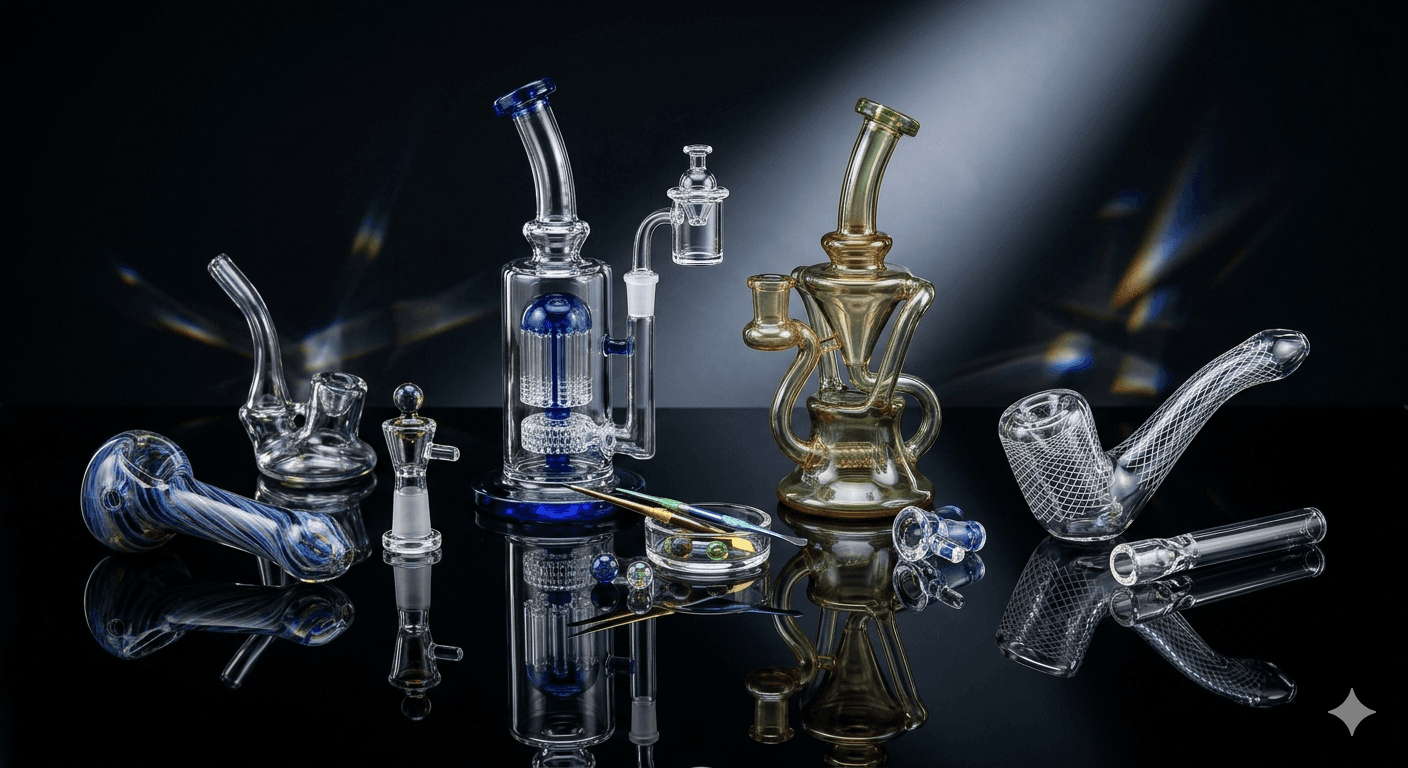
The category spans everything from basic chillums to high-end scientific glass. The shops doing it right give glass a generous share of their display space and keep both ends of the price range stocked.
One trend worth watching: the growing demand for locally blown and small-batch pieces. Customers increasingly want something they can't find at the shop across town. Stocking a few unique pieces alongside your bread-and-butter imports gives you a pricing advantage that's hard to compete with online.
Domestic vs. Imported Glass — Pros and Cons
This is one of the most important decisions you'll make when building your glass inventory. Most successful smoke shops carry both, but the ratio depends on your market and customer base.
American-Made Glass
Domestic glass — primarily blown in regions like Southern California, the Pacific Northwest, and parts of the Midwest — commands higher wholesale prices but delivers significantly better margins.
Pros:
- Thicker, more durable borosilicate glass that holds up to daily use
- Unique designs and colorwork that justify premium pricing
- Faster shipping, typically 3-7 business days
- Easier returns and communication with suppliers
- Strong brand recognition with knowledgeable customers
Cons:
- Wholesale prices are typically 2x to 4x higher than comparable imports
- Smaller production runs mean popular pieces sell out fast
- Lead times on custom orders can stretch to 4-8 weeks
A basic American-made spoon pipe wholesales for around $8 to $15. A mid-range water pipe runs $25 to $80 wholesale. Heady or artist-collab pieces can wholesale from $100 to $500+. Your retail markup on domestic glass should target 150% to 250%.
Browse wholesale glass and pipe suppliers on SmokeAxis to compare domestic options side by side.
Imported Glass
Most imported glass comes from China, with smaller volumes from India and Mexico. It fills the entry-level and mid-range slots in your display case.
Pros:
- Significantly lower wholesale costs — basic pipes from $1 to $5 each
- Large production capacity means consistent stock availability
- Good for high-volume, impulse-buy price points ($10-$25 retail)
- Many importers offer mixed cases so you can test styles without committing to 100 of the same piece
Cons:
- Quality varies wildly between suppliers — and sometimes between batches from the same supplier
- Thinner glass means higher breakage rates in transit and in-store
- Longer lead times (2-6 weeks for ocean freight), plus potential customs delays
- Fewer unique designs — your competitor down the street may carry the same pieces
Here's something counterintuitive: cheaper imported glass can actually cost you more per sale when you factor in breakage, returns, and the display space wasted on pieces that sit for months. A $2 wholesale pipe that breaks during a customer demo or gathers dust for 90 days isn't saving you anything.
The smart play is to use imports for your sub-$20 retail price points and fill your mid-range and premium tiers with domestic or small-batch glass.
What to Look for in a Wholesale Glass Supplier
Not all wholesale glass pipe suppliers are created equal. Here's what separates a supplier who'll help grow your business from one who'll drain your time and money.
Packaging and shipping quality. This is non-negotiable for glass. Every piece should be individually wrapped in bubble wrap or foam, with dividers between items. Ask potential suppliers how they pack shipments before you order. If they can't give you a clear answer, move on. Breakage rates above 2-3% on arrival signal a packaging problem that won't fix itself.
Breakage policy. What happens when pieces arrive broken? The best suppliers offer full replacement or credit with photo documentation. Some require you to file a claim within 24-48 hours of delivery. Get this in writing before your first order. A supplier with no breakage policy is telling you they expect you to eat the loss.
Consistent inventory. Your bestsellers need to be reorderable. If a $22 retail spoon pipe is flying off your shelf, you need to be able to reorder it next month — not hear "that style's discontinued" every time you call. Ask suppliers what percentage of their catalog is evergreen versus seasonal.
Sample orders. Any reputable glass supplier should let you order samples or a small introductory pack before committing to a full case order. If they won't send you 5-10 pieces to evaluate quality, that's a red flag.
Product photography. This matters more than you'd think. If you sell online or post inventory to social media, you need clean product images. Many wholesale suppliers now provide high-resolution photos of their pieces for retail partners.
Variety across price points. Your display case needs $8 hand pipes and $200 rigs. A supplier who only covers one end of the spectrum forces you to manage multiple vendor relationships, which adds complexity to your ordering and accounting.
For a broader look at complementary products like grinders, screens, and cleaning supplies, check out wholesale smoke shop accessories on our directory.
Minimum Orders and Pricing Expectations
Understanding glass wholesale pricing keeps you from overpaying or getting locked into orders that are too large for your shop's cash flow.
Typical Minimums
Minimum order requirements vary widely across glass suppliers:
- Imported glass distributors: Often $150 to $500 minimum, sometimes with no minimum on reorders
- Domestic glass wholesalers: Typically $250 to $1,000 minimum for first orders
- Direct-from-artist: Usually $500+ minimum, sometimes higher for custom work
- Mixed-case wholesalers: Around $200 to $400, which lets you sample a range of styles in one shipment
Pricing Benchmarks (Wholesale)
These numbers give you a rough baseline. Actual prices depend on volume, supplier, and whether you're buying imported or domestic.
| Product Type | Imported Wholesale | Domestic Wholesale | Typical Retail |
|---|---|---|---|
| Spoon/hand pipe | $1 – $5 | $8 – $18 | $10 – $45 |
| Sherlock pipe | $3 – $8 | $12 – $30 | $20 – $60 |
| Small water pipe (8-10") | $8 – $20 | $25 – $60 | $35 – $120 |
| Medium water pipe (12-16") | $15 – $40 | $50 – $120 | $60 – $250 |
| Dab rig | $10 – $35 | $40 – $150 | $50 – $300 |
| One-hitter/chillum | $0.50 – $2 | $5 – $12 | $5 – $25 |
Volume discounts. Most suppliers offer tiered pricing. Buying 50+ of the same piece instead of 10 can cut your per-unit cost by 15% to 30%. If you've got a proven bestseller, buying deeper saves real money.
Shipping costs. Glass is heavy and needs careful handling. Expect to pay $15 to $50+ for shipping depending on order size and distance. Some suppliers offer free shipping above a certain threshold — typically $500 to $1,000. Factor this into your cost-per-piece calculation. A $3 wholesale pipe with $4 of allocated shipping cost is really a $7 pipe.
Many California-based glass suppliers offer faster shipping to West Coast shops and sometimes lower freight costs due to proximity to major ports.
Questions to Ask Before Ordering
Before you send money to any glass supplier, get answers to these questions. They'll save you headaches and protect your margins.
-
What's your breakage policy? Get specifics — timeframe for filing claims, whether they replace or credit, and what documentation they need. "We'll take care of it" isn't a policy.
-
Can I order a sample pack? You need to hold the glass in your hands before committing to a 50-piece order. Quality that looks fine in photos can feel cheap in person.
-
What's your return policy on slow-moving inventory? Some suppliers offer exchange programs where you can swap styles that aren't selling. This is a huge advantage for managing dead stock.
-
How do you pack shipments? Individual wrapping, foam inserts, double-boxing — these details matter. Ask for photos of how they pack a typical order.
-
What's your typical lead time? Know the difference between "ships in 3 days" and "arrives in 3 days." During peak seasons (4/20, holiday), lead times can stretch significantly.
-
Do you offer net terms? Paying upfront on every order ties up cash. Established shops should ask about Net 15 or Net 30 terms. Most suppliers require 3-6 months of order history before extending credit.
-
What are your bestsellers right now? A supplier who can't immediately rattle off their top 5 pieces doesn't know their own inventory well enough to advise you.
-
Do you carry accessories that pair with your glass? Downstems, bowls, ash catchers, cleaning products — buying these from the same supplier simplifies your ordering.
Red Flags When Choosing a Glass Supplier
Years of watching shops succeed and fail with glass suppliers have made certain warning signs easy to spot. Walk away if you see any of these.
No breakage policy or a policy buried in fine print. Glass breaks in transit. Every legitimate supplier knows this and has a straightforward process. If they dodge the question or point you to a 12-page terms document, they're planning to make breakage your problem.
Pricing that's too good to be true. If someone's offering water pipes at 50% below what every other supplier charges, either the glass quality is terrible or the pieces are misrepresented. Occasionally it's stolen goods. None of those scenarios end well for you.
No physical address or verifiable business information. A legitimate glass wholesaler has a warehouse, a business license, and a phone number that a real person answers. If the only way to reach them is through a web form or WhatsApp, keep looking.
Pressure to place a large first order. Good suppliers want a long-term relationship. They'd rather you start with a $300 test order and come back every month than push you into a $3,000 order you can't move. Anyone pressing you to "buy big to get the price" on your first interaction is prioritizing their cash flow over your success.
Inconsistent product photos. If the photos on their website look like they're pulled from five different sources — different lighting, different backgrounds, different image quality — that's often a sign they're dropshipping or aggregating from multiple factories without quality control.
No reviews or references. Ask for references from other smoke shops they supply. If they can't or won't provide them, that tells you something. You can also search our supplier directory for verified distributors with ratings from other shop owners.
They don't know compliance basics. While glass pipes themselves don't carry the same regulatory burden as tobacco or vape products, any supplier selling to smoke shops should understand basic shipping regulations, age verification on delivery where required, and state-specific rules about marketing. A supplier who's oblivious to compliance is a supplier who could create problems for you.
FAQ
How much should I budget for my first glass inventory order?
For a new smoke shop, plan on roughly $2,000 to $5,000 for an initial glass inventory that covers multiple price points. This gets you a decent mix of hand pipes, a selection of water pipes, and a few premium pieces to anchor your display. Start conservative — it's easier to reorder bestsellers than to sit on $8,000 of glass that doesn't move.
What's the typical markup on wholesale glass pipes?
Most smoke shops target 100% to 200% markup on imported glass and 150% to 300% on domestic or artisan pieces. A pipe you buy for $5 wholesale might retail for $15 to $20. A domestic rig purchased at $60 wholesale could retail for $150 to $180. Your local market, competition, and store positioning all affect where you land in that range.
Should I buy glass directly from artists or go through a distributor?
Both have a place in your strategy. Distributors give you variety, lower minimums, and simpler logistics. Buying direct from artists gets you exclusive pieces with higher margins and gives your shop a unique identity. Many successful shops source most of their glass through distributors and fill the rest with direct artist relationships.
How do I handle breakage in shipments?
Document everything immediately. Photograph broken pieces in the original packaging before removing them. File a claim with the supplier within their stated window — usually 24 to 48 hours. Keep all packaging materials until the claim is resolved. Good suppliers will ship replacements or issue credit within a week. If a supplier fights you on a legitimate breakage claim, that's your cue to find a new supplier.
Is it worth stocking imported glass or should I go all domestic?
Almost every shop benefits from carrying both. Imported glass fills your impulse-buy price points ($10-$25 retail) where volume matters more than uniqueness. Domestic glass covers your mid-range and premium tiers where customers are willing to pay for quality and design. The shops that go 100% imported compete only on price. The shops that go 100% domestic price out a big chunk of walk-in customers. The sweet spot for most shops is around 40% to 60% imported and the rest domestic.
Start Building Your Glass Supply Chain
Finding reliable wholesale glass pipe suppliers takes some work upfront, but it pays off every month in better margins, fewer headaches, and a display case that actually moves product.
Start by browsing verified glass and pipe suppliers in our directory. Compare suppliers by location, minimums, and product range. Request samples from two or three before committing to larger orders.
You can also search all wholesale suppliers on SmokeAxis to find distributors across every product category your shop needs. The best time to lock in supplier relationships is before your busy season — not during it.